
AI & Tools
AI Business Ideas You Can Start Today (No Tech Skills Needed)

AI is everywhere right now.
You hear people say:
- “AI businesses are the future.”
- “You can start with zero money.”
- “This is your chance to escape the 9–5.”
But instead of feeling excited, you might feel confused, anxious, or stuck.
Where do you begin?
What if you choose the wrong idea?
What if you don’t have technical skills?
Here’s the good news: You don’t need to be a tech expert to start an AI business.
In fact, many of the best AI business ideas in 2026 are simple, service-based, and beginner-friendly. They use AI tools as helpers—not replacements for you.
In this guide, I’ll walk you through:
- The right mindset to approach AI business calmly
- Proven AI business ideas you can start today
- How to pick one idea without overthinking
- A simple system to track progress and stay motivated
No hype. No pressure. Just clarity and control.
Step One: The Right Mindset for Starting an AI Business
Before choosing tools or ideas, let’s clear something up.
AI Is Not the Business — You Are
Many beginners think:
“I need to build something complex with AI.”
You don’t.
AI is just a support system.
The real business is solving a problem for someone else.
Think of AI like a calculator.
It doesn’t make you rich.
It just helps you work faster and with fewer mistakes.
Focus on Ease, Not Perfection:
If you feel overwhelmed, that’s a signal—not a failure.
The goal is:
- Less stress
- More clarity
- Small, steady progress
You are not trying to build a billion-dollar startup.
You are building confidence and control first.
How AI Businesses Actually Work?
Let’s break this down simply.
The Basic AI Business Model:
Every successful AI business follows this structure:
Problem → AI Tool → Simple Solution → Payment
For example:
- Businesses struggle to create content → AI helps → You offer content services
- Creators lack time → AI saves time → You offer automation help
You don’t sell AI.
You sell results, powered by AI.
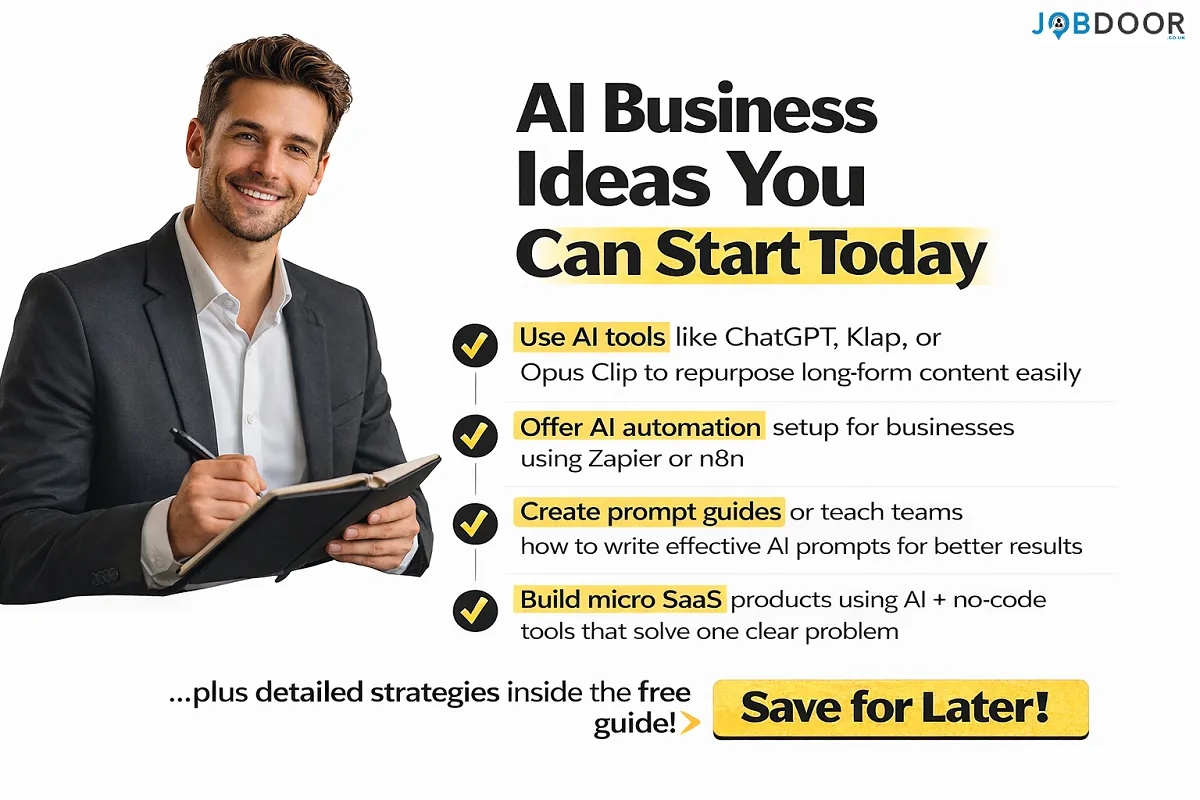
AI Business Ideas You Can Start Today:
Let’s explore the most practical ideas from the image—explained in plain English.
1. Repurpose Content Using AI Tools:
What This Means?
Many creators already have:
- Long YouTube videos
- Podcasts
- Blog posts
They want this content turned into:
- Short videos
- Social media posts
- Reels and shorts
AI tools can do this quickly.
What You Actually Do?
You:
- Take long content
- Use AI to break it into smaller pieces
- Deliver ready-to-post content
Why This Works?
- High demand
- Low skill barrier
- Fast results
Who Pays for This?
- YouTubers
- Coaches
- Podcasters
- Small brands
This is one of the best AI business ideas for beginners.
2. Offer AI Automation Setup for Small Businesses:
This sounds technical—but it doesn’t have to be.
What Is AI Automation?
Automation means:
Letting software do repetitive tasks automatically.
Examples:
- Sending emails
- Updating spreadsheets
- Posting content
- Managing leads
AI tools make this easier than ever.
What You Offer?
You help businesses:
- Save time
- Reduce manual work
- Stay organized
You’re not coding.
You’re connecting tools.
Why Businesses Love This?
Time = money.
If you help a business save 5–10 hours a week, they are happy to pay.
3. Create and Sell AI Prompt Guides:
This is one of the simplest AI business ideas.
What Is a Prompt Guide?
A prompt is just:
The instruction you give AI.
A prompt guide is:
- A document
- A checklist
- A mini-course
It teaches people what to ask AI to get better results.
Why This Works?
Most people use AI poorly.
They don’t know:
- What to type
- How to structure prompts
- How to refine answers
You become the guide.
How Beginners Start?
- Pick one audience (students, marketers, freelancers)
- Create simple prompt examples
- Package them neatly
No tech skills needed.
4. Teach Teams How to Use AI Effectively:
Many companies want AI—but don’t know where to begin.
What You Actually Teach?
You don’t teach AI theory.
You teach:
- How to save time
- How to avoid mistakes
- How to use AI safely and simply
Formats You Can Use?
- Workshops
- Video lessons
- One-on-one sessions
- Simple guides
If you can explain things clearly, this is powerful.
5. Build a Micro SaaS Using AI + No-Code Tools:
This sounds big—but it can start small.
What Is a Micro SaaS?
Micro SaaS means:
A very small software that solves one clear problem.
Not 100 problems.
Just one.
Example Ideas:
- AI email rewriter for sales
- AI resume checker
- AI content planner
- AI caption generator for Instagram
Why This Is Beginner-Friendly Now?
No-code tools mean:
- No programming
- Visual builders
- Faster launches
Start simple.
Improve later.
How to Choose ONE AI Business Idea?
Too many choices cause paralysis.
Use this simple filter.
Ask Yourself These 3 Questions
- What feels easiest for me to try?
- What problem do I understand best?
- What can I start this week?
Don’t choose the “best” idea.
Choose the simplest next step.
The 7-Day Starter Plan:
Here’s a realistic plan.
Day 1–2: Learn the Basics
- Watch tutorials
- Explore one AI tool
- Take notes
Day 3–4: Practice Privately
- Try small tasks
- Make mistakes
- Build confidence
Day 5–6: Create a Simple Offer
- One service
- One outcome
- One price
Day 7: Take Action
- Post online
- Message potential clients
- Share your service
No rush.
No pressure.
Just progress.
How to Track Success?
Tracking doesn’t mean spreadsheets and pressure.
Track These 3 Things Weekly:
- Time spent learning
- One action taken
- One lesson learned
That’s it.
If you show up weekly, you are winning.
Common Beginner Mistakes to Avoid:
Let’s save you frustration.
❌ Trying to learn everything
❌ Buying too many tools
❌ Waiting to feel “ready”
❌ Comparing yourself to experts
Instead:
✔ Start small
✔ Keep it simple
✔ Improve step by step
What Real Progress Looks Like?
Progress is not overnight success.
It looks like:
- First small client
- First ₹500 earned
- First positive feedback
- First confident decision
These moments matter.
Conclusion:
AI is not here to overwhelm you.
It’s here to support you.
You don’t need:
- Technical skills
- Big investments
- Perfect plans
You need:
- One clear idea
- One helpful tool
- One small action today
Choose one AI business idea from this guide.
Commit to one week of focused effort.
Let momentum do the rest.
You are not late.
You are right on time.
Start today. Even a small step counts.

Human Resources has always been about people. But today, HR professionals are expected to manage recruitment, employee engagement, performance tracking, and compliance—all at once.
If you work in HR, you probably know the feeling. Endless resumes. Dozens of interviews. Manual paperwork. Constant emails.
It can feel overwhelming.
Now imagine if AI could take care of the repetitive work, leaving you with more time to focus on what truly matters: building strong teams and supporting employees.
That’s exactly what modern AI tools for HR professionals are designed to do.
The challenge?
Most people don’t know where to start.
This guide will walk you through five powerful AI tools specifically designed for HR professionals, and more importantly, show you how to use them as a simple system that makes your work easier—not more complicated.
By the end of this article, you will learn:
- How AI can simplify recruitment and HR workflows
- The five most relevant AI tools for HR teams
- A step-by-step system to start using them without stress
- How to track success and improve HR performance
Let’s begin.
Why AI is Becoming Essential for HR Professionals?
HR is evolving quickly. Companies now receive hundreds or even thousands of applications for a single position.
Sorting them manually is exhausting.
AI helps by:
- Filtering resumes instantly
- Scheduling interviews automatically
- Improving candidate matching
- Analyzing employee engagement
- Reducing repetitive administrative work
But here’s the important part.
AI does not replace HR professionals.
It supports them.
Think of AI as your assistant, not your replacement.
Instead of spending hours on administrative tasks, you can focus on:
- Building relationships with employees
- Improving company culture
- Strategic hiring decisions
Now let’s explore the tools that make this possible.
1. HireVue – AI-Powered Interview and Candidate Screening:
One of the biggest HR challenges is screening candidates efficiently.
Imagine receiving 800 applications for a job opening.
Reading every resume and conducting preliminary interviews manually could take weeks.
How HireVue Helps?
HireVue uses AI to analyze:
- Candidate video interviews
- Speech patterns
- Skills and responses
- Job compatibility
Instead of scheduling dozens of phone calls, candidates can record video responses to preset questions.
The AI then helps HR teams identify the most promising applicants quickly.
Key Benefits:
- Faster hiring process
- Reduced recruiter workload
- Standardized interviews
- Better candidate insights
Simple Example:
Think of it like pre-recorded interviews.
Candidates answer questions on their own time, and you review them later.
No scheduling chaos.
Just clarity.
2. Pymetrics – AI for Skill Matching and Talent Discovery:
Resumes don’t always reveal a person’s true abilities.
Someone might look perfect on paper but struggle in real job situations.
This is where Pymetrics becomes valuable.
What Makes Pymetrics Different?
Instead of relying only on resumes, Pymetrics uses neuroscience-based games to evaluate candidates.
These short assessments measure traits like:
- Problem solving
- Risk tolerance
- Emotional intelligence
- Decision making
- Focus and attention
AI then compares these traits with successful employees already working in the company.
The result?
Better hiring matches.
Why HR Teams Love It?
- Reduces hiring bias
- Identifies hidden talent
- Focuses on real skills rather than just resumes
A Simple Way to Understand It:
Imagine hiring based on how people think, not just what they wrote on their resume.
That’s what Pymetrics does.
3. Paradox (Olivia) – AI Recruiting Assistant:
Recruiters spend a huge amount of time answering simple questions:
- “Did you receive my application?”
- “When is my interview?”
- “What is the job description?”
These messages pile up quickly.
Paradox solves this with an AI assistant called Olivia.
What Olivia Does?
Olivia works like a smart recruiting chatbot that can:
- Answer candidate questions instantly
- Schedule interviews automatically
- Send reminders to applicants
- Collect candidate information
The best part?
It works 24/7.
Candidates get instant responses, and HR teams save hours every week.
Benefits:
- Faster communication
- Better candidate experience
- Less administrative work
You step in only when human judgment is needed.
4. Eightfold AI – Intelligent Talent Management
Hiring is only one part of HR.
The real challenge is managing and growing talent inside the company.
Eightfold AI focuses on exactly that.
What Eightfold AI Does?
It analyzes employee data to help companies:
- Identify internal talent
- Recommend career paths
- Suggest training opportunities
- Improve workforce planning
In simple terms, it helps HR teams develop employees instead of constantly hiring new ones.
Why This Matters?
Employee retention is expensive.
Replacing workers costs companies thousands of dollars.
Eightfold AI helps organizations retain talent by identifying growth opportunities.
Eightfold AI can detect this and recommend a data analytics role or training program.
This keeps employees engaged and motivated.
5. Lattice – AI-Supported Employee Performance Management
Performance reviews are another major HR responsibility.
But traditional reviews often feel:
- Infrequent
- Subjective
- Stressful
Lattice modernizes this process.
How Lattice Works?
Lattice helps HR teams:
- Track employee goals
- Monitor progress
- Gather feedback
- Measure performance trends
AI analyzes performance data to provide insights about:
- Employee engagement
- Productivity
- Growth opportunities
Why It Matters?
Instead of waiting for annual reviews, companies can monitor performance continuously.
Employees also receive more consistent feedback, which improves development.
A Simple 4-Step System for Using AI in HR:
If all of this sounds overwhelming, don’t worry.
You don’t need to adopt every tool at once.
Start small.
Here is a simple system you can follow.
Step 1: Identify Your Biggest HR Bottleneck
Ask yourself:
- Is recruitment taking too long?
- Are interviews difficult to manage?
- Is employee performance hard to track?
Choose one problem to solve first.
Example:
If recruitment is slow, start with HireVue or Paradox.
Step 2: Implement One Tool at a Time
Trying multiple tools simultaneously often leads to confusion.
Instead:
- Choose one AI tool
- Train your HR team
- Run a small pilot program
- Gather feedback
Once it works well, expand gradually.
Step 3: Combine AI With Human Judgment
AI is powerful.
But it should never replace human decision-making.
Use AI to:
- Filter data
- Analyze trends
- Automate repetitive tasks
Use human intuition to:
- Make hiring decisions
- Understand employee emotions
- Build relationships
This balance is where the real magic happens.
Step 4: Track Your Results
How do you know if AI is helping?
Measure key HR metrics such as:
| Metric | What It Shows |
|---|---|
| Time to hire | How quickly positions are filled |
| Candidate satisfaction | Interview experience quality |
| Employee retention | How many employees stay |
| Hiring quality | Performance of new hires |
Even small improvements can make a huge difference over time.
Common Mistakes HR Teams Make With AI:
Many organizations adopt AI but fail to get real results.
Why?
Because of these common mistakes.
1. Using Too Many Tools:
More tools does not mean better results.
Focus on the tools that solve real problems.
2. Ignoring Employee Training:
New technology requires training.
Without proper guidance, teams may avoid using the tool entirely.
3. Expecting Instant Results:
AI improves processes gradually.
Think of it as long-term optimization, not instant transformation.
The Mindset Shift HR Professionals Need:
Using AI effectively starts with the right mindset.
Some HR professionals worry that AI will make their roles less valuable.
The truth is the opposite.
AI removes repetitive tasks, allowing HR professionals to focus on:
- Leadership
- Strategy
- Employee development
- Culture building
The future HR professional is not replaced by AI.
They are empowered by it.
The Future of AI in Human Resources:
The HR industry is entering a new era.
In the coming years, AI will help companies:
- Predict employee turnover
- Improve workplace wellbeing
- Personalize employee development
- Optimize hiring decisions
Organizations that adopt these technologies early will have a huge competitive advantage.
And HR professionals who learn these tools today will become indispensable leaders tomorrow.
Final Thoughts:
If HR tasks feel overwhelming, you’re not alone.
Recruitment pressure, employee expectations, and administrative work can create constant stress.
But AI offers a solution.
Not a complicated one.
A practical one.
By using tools like:
- HireVue for smarter interviews
- Pymetrics for skill-based hiring
- Paradox for automated recruiting
- Eightfold AI for talent management
- Lattice for performance tracking
You can transform HR from a reactive role into a strategic powerhouse.
Remember this simple approach:
- Identify one HR problem
- Choose one AI tool
- Implement gradually
- Measure results
Small steps lead to big improvements.
The most important thing?
Start today.
Because the future of HR is not just about managing people.
It’s about empowering them with the right technology.

Creating AI solo camping ASMR videos has become one of the fastest-growing content niches on YouTube and short-form platforms. Videos showing peaceful forest environments, tent setups, rain sounds, fire crackling, and quiet camping routines regularly attract millions of views.
Why? Because people crave calm.
After a stressful day, viewers want something relaxing—no talking, no chaos. Just nature, soft sounds, and a cozy visual story.
But many beginners think they need expensive cameras, remote forests, and professional editing skills.
That’s not true.
Today, AI tools and smart workflows allow anyone to create cinematic camping videos—even from home.
If you’ve ever wondered:
- “Can I create these videos without camping experience?”
- “What tools do I need?”
- “How do these videos go viral?”
You’re in the right place.
In this guide, you’ll learn:
- The mindset behind viral ASMR camping videos
- How to plan relaxing visual stories
- The best AI tools specifically for this niche
- How to create cinematic visuals and immersive sound
- A step-by-step workflow beginners can follow
- How to track success and grow your channel
Let’s begin.
Understanding Why Solo Camping ASMR Videos Go Viral:
Before creating anything, it helps to understand why these videos work so well.
Successful ASMR camping videos trigger three powerful viewer responses.
1. Calm and Relaxation:
Viewers watch to relax, sleep, or escape stress.
Soft rain.
Fire crackling.
Leaves moving.
These natural sounds create a peaceful mental space.
2. Visual Escapism:
Not everyone can travel into forests or mountains.
But a well-made video allows them to experience it virtually.
This is why scenes like:
- setting up a tent in the rain
- cooking quietly by the fire
- walking through foggy woods
perform extremely well.
3. Slow, Satisfying Storytelling:
Unlike fast-paced YouTube content, ASMR camping videos are slow and intentional.
Simple actions become relaxing rituals:
- unpacking gear
- lighting lanterns
- brewing coffee
When done well, viewers stay longer.
And long watch time = better ranking on YouTube.
The Beginner Mindset: Keep It Simple
Many beginners quit early because they think the process is complicated.
It’s not.
Your goal is not to create Hollywood films.
Your goal is to create a calming experience.
Think of your video like a quiet story.
Instead of dialogue, your story uses:
- visuals
- natural sounds
- slow actions
Imagine inviting someone into a peaceful campsite.
That’s the mindset.
Step 1: Choose Your Solo Camping Theme
Every viral video starts with a clear theme.
A theme makes your video easier to watch and more memorable.
Some examples include:
Rain Camping
Rain hitting the tent.
Steam from hot coffee.
Cozy atmosphere.
These videos often perform extremely well.
Snow Camping:
Soft snowfall.
Warm fire contrast.
Quiet winter forests.
Forest Survival Style:
Cutting wood.
Building shelter.
Cooking outdoors.
Luxury Relaxing Camping:
Beautiful tents.
Warm lighting.
High-quality visuals.
Choose one theme per video.
This keeps the experience focused.
Step 2: Plan the Scene Sequence
Think of your video like a simple journey.
A good ASMR camping video usually follows this order.
1. Arrival:
Walking into the forest or campsite.
2. Setting Up:
Building the tent.
Preparing the campsite.
3. Relaxing Moment:
Cooking.
Drinking coffee.
Listening to rain.
4. Night Atmosphere:
Firelight.
Lantern glow.
Calm environment.
5. Ending Scene:
Quiet closing moment.
Simple. Calm. Complete.
Step 3: Generate Cinematic Camping Visuals with AI
Now comes the creative part.
If you cannot travel to forests regularly, AI visual generation tools can help create stunning environments.
Here are the most useful tools for this niche.
Runway:
Runway is excellent for AI video generation and scene animation.
You can create short cinematic clips such as:
- rain falling on tents
- walking through misty forests
- fire glowing at night
These clips can be combined to create a full video.
Pika:
Pika specializes in AI-generated motion scenes.
It works well for:
- forest movement
- fog effects
- atmospheric environments
These small details make the video feel alive.
Kaiber:
Kaiber helps turn images into cinematic moving scenes.
You can animate:
- lantern lighting
- campsite views
- foggy forests
This adds motion without needing expensive filming equipment.
Step 4: Create Immersive ASMR Audio
In ASMR videos, sound is more important than visuals.
Bad audio will ruin even the best-looking video.
Focus on realistic nature sounds.
ElevenLabs:
ElevenLabs can generate natural environmental audio layers.
Examples include:
- rain ambience
- fire crackling
- forest atmosphere
These sounds help build immersion.
Adobe Podcast Enhance:
If you record your own sounds, this tool helps clean background noise and improve clarity.
Even simple recordings can sound professional.
Step 5: Edit the Video Like a Calm Story
Editing is where everything comes together.
The goal is not flashy editing.
Instead, focus on slow, relaxing transitions.
Descript:
Descript allows simple editing with:
- easy trimming
- scene sequencing
- sound layering
You can combine visuals and sound while keeping the workflow simple.
CapCut Desktop:
CapCut is excellent for:
- smooth transitions
- subtle motion effects
- lighting adjustments
Just remember:
Less editing is better for ASMR videos.
Let the visuals breathe.
Step 6: Create a Clickable Thumbnail
Your thumbnail is the first impression.
It determines whether people click.
A strong ASMR camping thumbnail usually includes:
- warm fire glow
- cozy tent lighting
- misty forest atmosphere
Keep text minimal.
Example:
“Rain Camping Alone in the Forest”
Large, clear text works best.
Step 7: Optimize Your Video for SEO
Creating the video is only half the job.
You also need people to find it.
Use keywords that viewers search for.
Example Primary Keywords:
- AI solo camping videos
- camping ASMR video
- relaxing camping ambience
Example Secondary Keywords:
- forest camping relaxation
- rain camping ambience
- peaceful camping sounds
Include them in:
- title
- description
- tags
Example Title Structure:
A good title combines curiosity and clarity.
Examples:
- Solo Rain Camping in the Forest | Relaxing ASMR
- Peaceful Night Camping with Fire Sounds
- AI Solo Camping ASMR – Relaxing Forest Escape
Avoid overly complicated titles.
Simple works better.
Step 8: Upload Consistently
Success rarely happens with one video.
Most creators see growth after 10–20 uploads.
Why?
Because the algorithm needs time to understand your content.
Try this schedule:
- 1 video per week
Consistency builds trust with viewers.
Step 9: Track Your Success
Instead of guessing what works, track your results.
Pay attention to these metrics.
Click Through Rate (CTR):
Shows how many people click your thumbnail.
Good CTR: 5% or higher
Average Watch Time:
Measures how long viewers stay.
ASMR videos often perform well here.
Audience Retention:
Shows where viewers stop watching.
Use this to improve future videos.
Example Beginner Workflow:
Here’s a simple system you can follow every week.
| Step | Task |
|---|---|
| 1 | Choose camping theme |
| 2 | Generate AI camping visuals |
| 3 | Add relaxing ASMR sound |
| 4 | Edit scenes slowly |
| 5 | Create a strong thumbnail |
| 6 | Upload with optimized title |
Repeat.
Improve each time.
Common Beginner Mistakes:
Avoid these mistakes early.
Too Much Talking:
ASMR camping videos should be quiet and immersive.
Fast Editing:
Slow pacing works better.
Loud Music:
Music often ruins the relaxing mood.
Nature sounds are enough.
How Long Should the Video Be?
Most successful camping ASMR videos are:
20 minutes to 2 hours
Longer videos help viewers:
- relax
- study
- sleep
And longer watch time helps ranking.
Final Thoughts:
Starting something new always feels intimidating.
But here’s the truth.
Every successful creator started with a simple first video.
Not perfect.
Not cinematic.
Just honest.
Focus on creating one peaceful experience.
A quiet forest.
Soft rain.
Warm firelight.
That’s enough.
Conclusion:
Creating AI solo camping ASMR videos is one of the most exciting opportunities for new creators today. The demand for relaxing, immersive content continues to grow, and viewers are actively searching for peaceful experiences online.
The good news is that you don’t need expensive gear or outdoor filmmaking skills to begin. With the right mindset, a clear theme, and a few powerful AI tools, you can create beautiful camping scenes that captivate viewers.
Remember the simple system:
- Choose a calm camping theme
- Generate cinematic visuals
- Add immersive nature sounds
- Edit with slow, relaxing pacing
- Optimize your title and thumbnail
- Upload consistently and track your results
Most importantly, don’t overthink it.
Your first video doesn’t have to be perfect. What matters is starting.
So take the first step today. Create your first peaceful camping video and share it with the world.
Who knows?
Your relaxing forest scene might be the one that helps millions of people unwind, sleep better, and escape stress for a while.
Artificial Intelligence is no longer a futuristic concept. It is already transforming how software is built, tested, and deployed. If you are a developer—or even someone thinking about entering the field—you might feel both excited and overwhelmed.
Maybe you’ve asked yourself questions like:
- Do I need to learn AI to stay relevant?
- Which tools actually matter?
- Where do I even start if I’m a beginner?
The truth is simple: AI tools are becoming a standard part of a developer’s workflow. Engineers who understand them can build faster, solve problems better, and stay competitive in the job market.
But here’s the good news.
You don’t need to learn everything at once. You only need to focus on the right tools and a clear system.
In this guide, you’ll discover:
- The most important AI tools software engineers should learn
- How these tools improve productivity and coding quality
- A step-by-step system to start using them confidently
- How to track your progress and build real skills
Let’s begin.
Why AI Tools Are Becoming Essential for Developers?
The role of a software engineer is changing.
In the past, developers spent most of their time writing code line by line. Today, AI can assist with:
- Code generation
- Debugging
- Documentation
- Code reviews
- Testing automation
Instead of replacing developers, AI amplifies their capabilities.
Think of AI as a smart coding partner that helps you move faster.
Developers who embrace AI can:
- Ship features faster
- Reduce repetitive work
- Focus on creative problem-solving
- Learn new technologies quicker
Companies are already prioritizing engineers who understand AI-assisted development workflows.
So learning these tools is no longer optional—it’s becoming a career advantage.
The Mindset Shift: AI as Your Coding Partner
Before diving into tools, let’s talk about mindset.
Many beginners worry:
“What if AI replaces programmers?”
In reality, the opposite is happening.
Developers who know how to use AI effectively are becoming more valuable.
Think of it this way:
- AI handles repetitive tasks
- You handle strategy, architecture, and creativity
It’s similar to how calculators changed mathematics. They didn’t replace mathematicians—they simply made complex calculations faster.
Your goal isn’t to compete with AI.
Your goal is to collaborate with it.
The Most Important AI Tools for Software Engineers:
Not every AI tool is worth your time. Some are overhyped, and others duplicate the same features.
Below are high-impact tools that genuinely improve a developer’s workflow.
1. GitHub Copilot:
If there is one AI tool every developer should try, it’s GitHub Copilot.
This tool acts like a real-time coding assistant inside your editor.
What GitHub Copilot Does?
Copilot analyzes the code you are writing and suggests:
- Complete lines of code
- Entire functions
- Documentation
- Test cases
It supports languages such as:
- Python
- JavaScript
- Java
- C++
- TypeScript
- Go
Why Developers Love It?
Copilot dramatically speeds up development by:
- Reducing repetitive coding
- Suggesting better implementations
- Helping you learn unfamiliar APIs
Imagine typing a comment like:
“Create a function to validate email format.”
Copilot will instantly generate the function for you.
Best Use Cases:
- Writing boilerplate code
- Learning new frameworks
- Building prototypes quickly
It’s like having a junior developer assisting you 24/7.
2. Cursor AI:
Cursor AI is a next-generation code editor designed specifically for AI-assisted development.
Unlike traditional editors, Cursor understands your entire codebase.
Key Features:
- AI that can read and modify your project
- Smart code explanations
- Refactoring assistance
- Bug detection
Instead of manually searching through files, you can ask questions like:
“Where is the authentication logic implemented?”
Cursor will show the relevant code instantly.
Why It’s Powerful?
Cursor turns your editor into a knowledgeable project assistant.
This is incredibly useful when:
- Working with large codebases
- Onboarding new developers
- Debugging complex issues
3. Codeium:
Not every developer wants a paid tool.
That’s where Codeium becomes valuable.
Codeium offers many AI coding features similar to Copilot, but completely free.
Features Developers Appreciate:
- AI code completion
- Multi-language support
- IDE integrations
- Smart code search
It works with editors like:
- VS Code
- JetBrains
- Neovim
Why It’s Beginner-Friendly?
If you’re just starting with AI coding tools, Codeium is an excellent risk-free starting point.
You can experiment and build confidence without spending money.
4. Replit Ghostwriter:
Replit Ghostwriter is especially helpful for students and beginner developers.
It integrates directly into the Replit coding environment.
What Makes Ghostwriter Unique?
Ghostwriter helps with:
- Code explanations
- Debugging suggestions
- Auto-generation of functions
- Educational guidance
This makes it perfect for:
- Learning programming
- Building small projects
- Practicing coding challenges
Think of it as a mentor that explains your code while you write it.
5. Tabnine:
Many companies worry about sharing their code with AI systems.
Tabnine addresses this by offering privacy-focused AI models.
What Tabnine Offers?
- AI code completion
- Secure enterprise options
- Private model training
- Team productivity features
Why Enterprises Prefer It?
Companies can run Tabnine in secure environments, ensuring that sensitive code stays protected.
For professional teams, this is a major advantage.
How AI Tools Improve the Development Workflow?
To understand the real value of AI tools, let’s look at how they transform daily tasks.
| Development Task | Traditional Approach | AI-Assisted Approach |
|---|---|---|
| Writing code | Manual coding | AI suggestions |
| Debugging | Searching documentation | AI analysis |
| Learning APIs | Reading docs | AI explanation |
| Refactoring | Time-consuming | AI recommendations |
| Documentation | Often skipped | AI auto-generation |
The result?
Developers save hours of work every week.
A Simple System to Start Using AI Tools:
Learning tools randomly can feel overwhelming.
Instead, follow this clear step-by-step system.
Step 1: Choose One Tool First
Avoid trying everything at once.
Start with one AI assistant, such as:
- GitHub Copilot
- Codeium
Use it daily for at least two weeks.
Step 2: Practice AI-Assisted Coding
Try using AI for:
- Writing functions
- Refactoring code
- Generating test cases
Observe how the suggestions improve your workflow.
Step 3: Ask AI to Explain Code
One powerful learning technique is asking AI to explain unfamiliar code.
For example:
“Explain what this function does step by step.”
This helps beginners learn faster while coding.
Step 4: Use AI for Debugging
Instead of spending hours searching forums, try:
- Asking AI to analyze an error
- Requesting a debugging explanation
- Getting possible solutions
This dramatically reduces frustration.
Step 5: Build Small Projects
The best way to learn AI tools is by building.
Start with simple projects such as:
- To-do list apps
- Blog systems
- API integrations
- Data dashboards
Let AI assist, but always review the code carefully.
Common Mistakes Developers Make With AI Tools:
AI tools are powerful—but they must be used wisely.
Avoid these mistakes.
1. Blindly Trusting AI Code:
AI suggestions are helpful, but not always perfect.
Always:
- Review the logic
- Test the output
- Understand the implementation
2. Over-Reliance on Automation:
AI should assist learning—not replace it.
Make sure you still understand:
- Algorithms
- Data structures
- System design
3. Ignoring Security Concerns:
AI-generated code can sometimes include vulnerabilities.
Always verify:
- Authentication logic
- Data validation
- Security practices
How to Measure Your Progress?
How do you know if AI tools are helping you?
Track these metrics.
Productivity:
Ask yourself:
- Am I writing code faster?
- Am I debugging quicker?
Code Quality:
Look for improvements in:
- Code readability
- Test coverage
- Documentation
Learning Speed:
AI tools can accelerate your learning.
You should notice that:
- New frameworks feel easier
- Documentation becomes clearer
- Problem solving improves
The Future of AI-Assisted Development:
AI is rapidly transforming software engineering.
In the next few years we will see:
- AI-generated entire applications
- Autonomous debugging systems
- Smart architecture suggestions
- Real-time security scanning
Developers who adapt early will gain a significant career advantage.
Those who ignore these tools may find themselves struggling to keep up.
But remember.
AI will not replace developers.
It will empower the best ones.
Final Thoughts:
Learning AI tools doesn’t have to be complicated.
You don’t need to master everything overnight.
Start with one tool.
Use it consistently.
Build small projects.
Over time, you’ll notice something powerful.
Tasks that once took hours will take minutes.
Your confidence will grow.
And instead of feeling overwhelmed by AI, you’ll feel in control of it.
So take the first step today.
Install an AI coding assistant, experiment with it, and begin integrating it into your daily workflow.
The developers who thrive in the future will not be the ones who fear AI.
They will be the ones who learn to work with it.

5 AI Tools for HR Professionals: Simplify Hiring & Management
Human Resources has always been about people. But today, HR professionals are expected to manage recruitment, employee engagement, performance tracking,...


How to Make Viral AI Solo Camping ASMR Videos?
Creating AI solo camping ASMR videos has become one of the fastest-growing content niches on YouTube and short-form platforms. Videos...

7 AI Tools Every Software Engineer Should Learn Before 2026
Artificial Intelligence is no longer a futuristic concept. It is already transforming how software is built, tested, and deployed. If...


How to Use SORA 2 to Create Viral Faceless YouTube Videos?
Have you ever wondered how some YouTube channels grow incredibly fast without ever showing a face on camera? You see...


Companies Pay $10K for This AI Masterclass: Learn the Skills That Are Reshaping the Future
Companies don’t pay for tools. They pay for systems, strategy, and transformation. A high-end AI masterclass teaches employees how to...

AI for Kids: The Fun and Easy Way to Understand Artificial Intelligence
Artificial Intelligence sounds like something from a science-fiction movie. Robots. Smart computers. Machines that think like humans. For many people,...


10 AI Myths and Facts Most People Still Believe (And the Truth Behind Them)
Artificial Intelligence is everywhere right now. You hear about it in the news. You see it in social media discussions....


5 Simple Things Successful People Do Before 8 AM
Have you ever wondered why some people seem to start their day full of energy, focus, and confidence? While others...
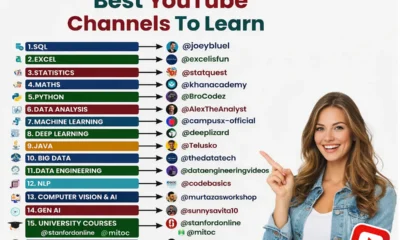

Best YouTube Channels to Learn Tech Skills for Free
Learning technology skills today is easier than ever. You don’t need expensive courses or a computer science degree anymore. YouTube...

12 Underrated Apps To Learn Something New Every Day
Let’s be honest. Most of us spend 3–5 hours a day on our phones. Scrolling social media. Watching random videos....

Google Launches Gemini 3.1 Pro: A Big Step Forward in Artificial Intelligence
Google has officially introduced Gemini 3.1 Pro, its newest and most powerful artificial intelligence model. This launch is part of...


How to Create Unlimited AI Videos in One Click for Free (2026 Guide)
Artificial Intelligence is changing how we create content online. Today, you don’t need expensive software, video editing skills, or hours...


How to Make AI Survival ASMR Videos in 2026: New Viral YouTube Niche
YouTube trends change very quickly. Every few months, a new content style appears and suddenly thousands of creators start using...


How to Run Meta Ads on a Small Budget ($100/Day Strategy That Actually Works)
Most businesses believe you need a huge advertising budget to get results from Meta Ads. That’s simply not true. In...


5 Free Facebook AI Tools to Solve 90% of Your Ad Problems
Running Facebook ads used to mean endless guesswork. You would test audiences manually, duplicate ad sets endlessly, refresh creatives every...

How to Automate Meta Ads Using Manus AI?
Meta Ads are evolving faster than ever. Manual optimization, endless A/B testing, creative fatigue, reporting stress — all of it...


How to Build Automated Online Income in 2026 – The “Sleepy” Side Hustle Blueprint
“Stop ignoring this.”“Boost your income.”“Get paid while you sleep.” You’ve seen headlines like that everywhere. Screenshots of large payouts. Smiling...


How to Sell on Amazon FBA in 2026: The Complete, Future-Proof Blueprint for Beginners & Growth Sellers
Amazon FBA (Fulfillment by Amazon) is no longer just a side-hustle trend. It’s a sophisticated eCommerce ecosystem where brand building,...

How to Outrank Your Competitors in ChatGPT? (2026 AI Guide)
You Google your brand inside ChatGPT… and nothing. Or worse — your competitors are everywhere. They’re recommended. They’re cited. They’re...


How to Get Instagram Followers with Meta Ads (Step-by-Step Funnel Strategy)
If your goal is to consistently add 20, 50, even 100+ new Instagram followers per day, and turn those followers...
-
 Career2 years ago
Career Opportunities for Seniors: 7 Jobs that are Perfect for Older Adults
-
 Money2 months ago
26 Lucrative Passive Income Ideas to Build Wealth in 2026
-

 Career1 year ago
5 Free Job Posting Sites in the UK (For Employers)
-
 Job Description2 years ago
Graphic Designer Job Description: Education, Salary, Skills, Work Hours
-
 News1 year ago
UK Government Offers £300 to Households: How to Claim Your Payment?
-

 AI & Tools2 months ago
ChatGPT vs Copilot: Which AI Is Best for You in 2026?
-
 Jobs2 months ago
15 Best Second Jobs to Boost Your Income in the UK for 2026
-

 Career2 years ago
13 Best Jobs That AI Can’t Replace: A Guide to Future-proof Careers