
Social Media
Why Negative Hooks Make Content Go Viral Faster?
If you’ve ever posted content that felt useful—but barely got any views—you’re not alone. You might have thought, “Is my content bad?” or “Why does everyone else seem to go viral except me?”
The truth is uncomfortable, but freeing:
Most content fails not because it lacks value, but because it lacks attention.
In today’s crowded online world, attention is the entry fee. And one of the most reliable ways to earn that attention is through something called negative hooks.
That phrase might sound intimidating. Don’t worry. This guide will walk you through it calmly and clearly.
By the end of this article, you’ll understand:
- What negative hooks actually are (in plain English)
- Why they work so well psychologically
- How to use them ethically—without fear or manipulation
- A simple system to create your own hooks
- How to track what’s working without stress
No hype. No pressure. Just a clear framework you can use today.
What Are Negative Hooks?
A hook is the first line that makes someone stop scrolling.
A negative hook does this by highlighting:
- A mistake
- A myth
- A hard truth
- A hidden problem
- An uncomfortable reality
In simple terms:
Negative hooks work because they point to what’s wrong before offering what’s right.
Think of a doctor saying, “If we ignore this symptom, it gets worse.” That gets your attention—not out of fear, but out of care.
Why Negative Hooks Go Viral?
Let’s keep this human.
People don’t scroll because they’re lazy. They scroll because they’re overwhelmed.
Negative hooks work because they:
- Interrupt autopilot thinking
- Trigger curiosity
- Feel honest and direct
- Match real frustrations people already feel
Our brains are wired to notice problems faster than promises. It’s a survival instinct.
That’s not manipulation. That’s awareness.
The Mindset Shift: Honest, Not Harsh
Many beginners avoid negative hooks because they fear sounding:
- Too aggressive
- Too negative
- Too “clickbait”
Here’s the mindset shift that changes everything:
You’re not attacking the person. You’re attacking the problem.
There’s a big difference.
You’re saying, “I see your struggle,” not “You’re doing everything wrong.”
When your intent is to help, your tone naturally softens.
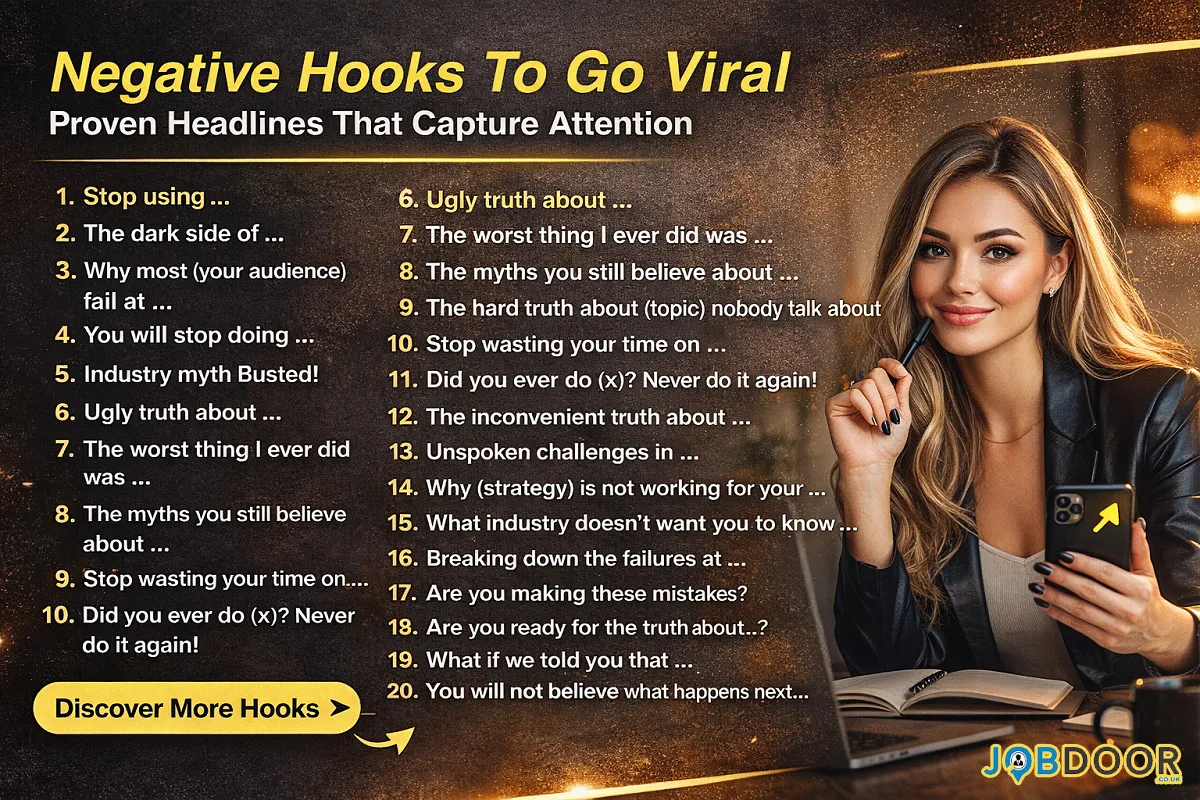
Common Types of Negative Hooks That Work:
Based on proven viral patterns, here are the most effective categories.
1. “Stop Doing This” Hooks:
These interrupt bad habits.
Examples:
- Stop using this content strategy
- Stop wasting time on this mistake
Why it works: People want relief from effort that isn’t paying off.
2. “The Ugly Truth” Hooks:
These feel honest and refreshing.
Examples:
- The ugly truth about going viral
- The hard truth nobody talks about
Why it works: People are tired of polished lies.
3. “Why Most People Fail” Hooks:
These normalize struggle.
Examples:
- Why most creators fail at content
- Why beginners don’t see growth
Why it works: It removes shame and creates belonging.
4. “Myths You Still Believe” Hooks:
These challenge assumptions.
Examples:
- The myths you still believe about engagement
- Industry myths busted
Why it works: Curiosity + ego gap.
5. “Mistake‑Based” Hooks:
These feel protective.
Examples:
- Are you making these mistakes?
- The worst thing I ever did was…
Why it works: People want to avoid regret.
A Simple Formula to Create Negative Hooks:
You don’t need to be clever. You need to be clear.
Use this beginner‑friendly formula:
Negative trigger + specific context + implied benefit
Example Breakdown:
- Negative trigger: Stop wasting your time
- Context: on viral hooks
- Implied benefit: there’s a better way
Put together:
Stop wasting your time on viral hooks that don’t convert
Simple. Calm. Effective.
Step‑by‑Step: Creating Your First Viral Hook
Let’s make this actionable.
Step 1: Identify the Pain
Ask:
- What frustrates my audience?
- What are they tired of trying?
Write one sentence.
Step 2: Name the Problem Directly
Avoid vague language.
Bad: You might be struggling
Better: Why most people fail at this
Clarity reduces anxiety.
Step 3: Soften the Tone
Balance honesty with empathy.
Add phrases like:
- Nobody talks about this
- You’re not alone
- This isn’t your fault
Step 4: Promise Insight, Not Drama
You don’t need shock.
You need reassurance that reading further is worth it.
Ethical Use of Negative Hooks (Very Important):
Negative hooks should guide, not scare.
Avoid:
- False urgency
- Shaming language
- Exaggerated fear
Instead, aim for:
- Truth
- Respect
- Practical solutions
If your content ends with clarity, you’re doing it right.
Where Negative Hooks Work Best?
They perform especially well on:
- Blog headlines
- Pinterest pins
- YouTube titles
- Instagram Reels
- Email subject lines
Anywhere attention is limited.
Tracking What Works:
You don’t need complex analytics.
Track only three things:
- Views
- Saves or shares
- Comments
Use a simple note or spreadsheet.
Patterns matter more than perfection.
Common Beginner Mistakes:
Using Negativity Without Value
Hooks open the door. Content keeps people inside.
Copying Without Understanding:
Templates help. Blind copying hurts trust.
Overthinking One Post:
Consistency beats brilliance.
A Simple Weekly System:
Keep it calm:
- Write 5 hooks
- Post 3
- Review results
- Improve 1 thing
That’s it.
Final Thoughts:
Negative hooks are not about being negative.
They’re about being honest, specific, and helpful.
When you name the problem your audience already feels, you reduce confusion—and build trust.
You don’t need to shout.
You don’t need to manipulate.
You just need to speak clearly.
Start with one hook today.
Write it.
Post it.
Learn from it.
That’s how attention grows.
And that’s how anxiety fades—one clear step at a time.



Choose an Entry-Level Jobs Based on Your Personality and Skills
Choosing your first job can be confusing. There are hundreds of entry-level jobs in the UK, but the best option...


Python Interview Cheat Sheet: 30 Python Concepts You Should Know Before Your Next Coding Interview
Python is one of the most popular programming languages for beginners and professional developers. It is widely used in web...

AI Could Replace Millions of Entry-Level Jobs in the UK by 2035: Which Roles Are Most at Risk?
Artificial intelligence is changing the way people work across the UK. From customer service and administration to data processing and...

How to Get a Job When There Are Fewer Vacancies
Looking for a job can become much more frustrating when there are fewer vacancies available. You may be checking job...

How UK Job Seekers Can Use LinkedIn to Find More Job Opportunities?
LinkedIn is no longer just a website for experienced professionals. It can be a useful job-search tool for students, graduates,...

Why Is It So Hard to Get a Job in the UK in 2026?
If you have been applying for jobs in the UK and getting very few replies, you are not alone. Many...


Entry-Level Jobs in the UK Compared: Pay, Difficulty, Stress and Career Growth
Starting your career can be confusing, especially when there are so many entry-level jobs available in the UK. While some...


Why Are Graduate Jobs Becoming Harder to Find in the UK?
Graduating from university is supposed to feel like the beginning of a new chapter. You finish your degree, prepare your...


30 Entry-Level Jobs in the UK for People With Little or No Experience
Finding your first job can feel difficult, especially when many vacancies ask for previous work experience. The good news is...


IBM Internship UK: A Complete Guide to Opportunities, Eligibility and How to Apply
An IBM internship can be an attractive opportunity for students and early-career candidates who want practical experience at a major...

How to Find Green Jobs in the UK: A Practical Guide for Job Seekers
Green jobs are becoming an important part of the UK employment market. As businesses, local authorities and industries focus more...

Top 10 Hosting Providers for Developers
Developers assess hosting differently from most other webmasters. While absolute costs and total disk space matter, the best web hosting...


HR Consultant Job Description: Duties, Skills, Salary and How to Become One in the UK
An HR Consultant helps organisations manage their people more effectively. They provide professional advice on areas such as HR policies,...


Meta and Microsoft Announce Massive Layoffs
Big tech companies like Meta Platforms and Microsoft are reducing their workforce as they spend more money on artificial intelligence...


GPT-5.5 vs Claude: Nano Banana Killer & Claude’s New Design Tool
Artificial Intelligence is evolving at an incredible pace. Every few months, new models and tools are released that push the...

Moltbook: The First Social Network for AI Agents
Artificial Intelligence is evolving rapidly. We’ve moved from simple tools to powerful AI systems that can write, design, analyze, and...


Volkswagen Uses AI Agents to Transform Its Cars in China
The automotive industry is changing faster than ever before—and at the center of this transformation is Artificial Intelligence (AI). One...

AI Is Growing Faster Than You Think
Artificial Intelligence (AI) is no longer something we only see in movies or imagine about the future. It is already...


Could AI Eliminate Humans in the Next 10 Years?
Artificial Intelligence (AI) is advancing at an incredible speed. Every day, new tools, smarter systems, and powerful technologies are being...


Meet NEO: Your New Home Robot Buddy
Imagine coming home after a long day, and instead of doing chores, managing devices, or worrying about security, everything is...
-
 Career3 years ago
Career Opportunities for Seniors: 7 Jobs that are Perfect for Older Adults
-
 Jobs7 months ago
15 Best Second Jobs to Boost Your Income in the UK for 2026
-

 Career2 years ago
5 Free Job Posting Sites in the UK (For Employers)
-
 How-to7 months ago
How to Make Money with Google Gemini: Practical Methods Anyone Can Start
-
 How-to7 months ago
How to Build Passive Income and Wealth: 26 Lucrative Ideas
-
 AI & Tools7 months ago
10 Insane Ways Google Gemini Will Explode Your Productivity in 2026
-

 Job Description2 years ago
Support Worker Job Description: Qualifications, Skills, Salary, Working Hours
-

 AI & Tools7 months ago
ChatGPT vs Copilot: Which AI Is Best for You in 2026?