AI & Tools
ChatGPT Prompts to Create Viral YouTube Shorts
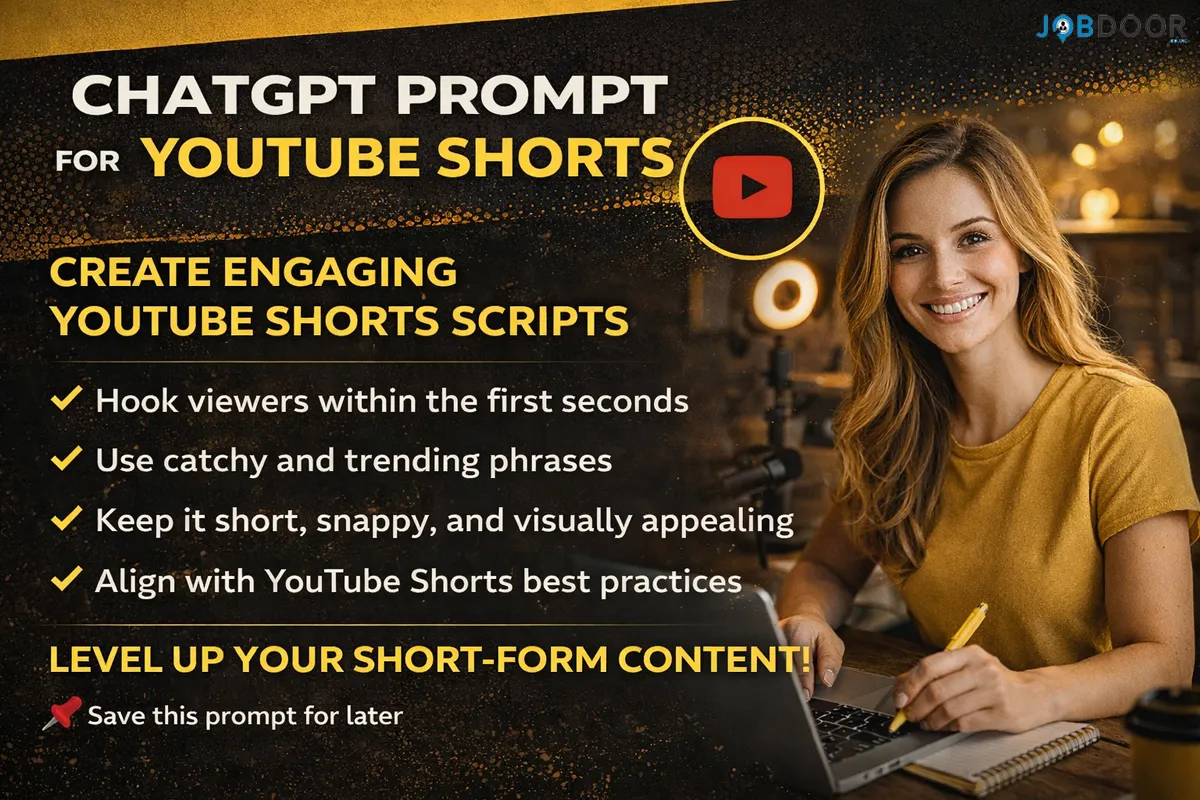
YouTube Shorts look simple on the surface.
A short video.
A few seconds.
Quick views.
But when you actually sit down to create one, your mind goes blank.
What should I say?
How do I hook people fast?
Why do others go viral while mine don’t?
If you’ve felt this confusion, you’re not alone.
The problem is not your creativity.
The problem is lack of structure.
YouTube Shorts reward clarity, speed, and focus. Most people fail because they try to “wing it” instead of following a repeatable system.
This is where ChatGPT prompts for YouTube Shorts change everything.
In this guide, you’ll learn:
- How YouTube Shorts actually work (in plain language)
- The right mindset for short-form content
- A simple step-by-step system to create Shorts
- 5 powerful ChatGPT prompts you can reuse daily
- How to track success without obsessing over views
No guesswork. No burnout. Just a calm, practical approach.
What Are YouTube Shorts?
YouTube Shorts are vertical videos under 60 seconds designed for fast consumption.
Their goal is simple:
👉 Stop scrolling and keep viewers watching
The algorithm cares about:
- Watch time
- Retention
- Replays
It does not care if you’re famous or new.
That’s good news.
Why Most People Fail at YouTube Shorts?
Let’s be honest.
Most Shorts fail because:
- The hook is weak
- The message is unclear
- The script rambles
- The creator overthinks
Short-form content punishes confusion.
It rewards focus.
That’s why scripting—even lightly—is not optional.
The Mindset Shift: You’re Not Making Videos, You’re Creating Moments
Here’s a powerful reframe:
A YouTube Short is not a video. It’s a moment.
One idea.
One emotion.
One takeaway.
When you try to teach too much, people scroll.
When you deliver one sharp insight, people stay.
ChatGPT helps you sharpen the message, not replace your voice.
Why ChatGPT Prompts Work So Well for YouTube Shorts?
ChatGPT is not magic.
But it is very good at:
- Structuring ideas
- Writing hooks
- Simplifying language
- Keeping things short and punchy
The quality of the output depends entirely on the prompt.
Bad prompt → generic script
Good prompt → scroll-stopping Short
That’s why prompts matter more than tools.
The Simple YouTube Shorts Creation System:
Before we jump into the prompts, let’s lock in a clear system you can repeat daily.
Step 1: Pick ONE Idea
Not a topic.
An idea.
Example:
- “Most people ruin YouTube Shorts by doing this”
- “This mistake kills watch time”
Step 2: Decide the Emotion
Choose one:
- Curiosity
- Surprise
- Relief
- Fear (light)
- Motivation
Step 3: Use a Prompt to Generate the Script
This removes mental load.
Step 4: Record Quickly
Don’t chase perfection.
Step 5: Post and Move On
Momentum beats obsession.
The 5 Best ChatGPT Prompts for YouTube Shorts (Copy & Paste):
These prompts are not generic.
They’re designed for retention, hooks, and clarity.
🔹 Prompt 1: The Instant Hook Script
Use this when you want to stop scrolling immediately.
“Act as a YouTube Shorts scriptwriter. Write a 20–30 second YouTube Shorts script that hooks viewers within the first 2 seconds.
The topic is: [YOUR TOPIC].
Start with a bold, curiosity-driven opening line.
Keep sentences short, punchy, and conversational.
End with a strong final line that makes viewers think or want more.”
Why this works:
Hooks first. Explanation later. Exactly what Shorts need.
🔹 Prompt 2: The “Common Mistake” Script
Perfect for educational or advice content.
“Write a YouTube Shorts script exposing a common mistake people make about [TOPIC].
Start by calling out the mistake directly.
Explain why it happens in simple language.
End with one clear takeaway.
Keep it under 40 seconds and optimized for retention.”
Why this works:
People love realizing they’re “doing it wrong.”
🔹 Prompt 3: The Step-by-Step Micro Guide
Use this for how-to content.
“Create a short YouTube Shorts script that teaches one simple step-by-step method for [GOAL].
Use numbers (Step 1, Step 2, Step 3).
Keep each step one sentence long.
Make it beginner-friendly and easy to remember.”
Why this works:
Clear structure reduces drop-offs.
🔹 Prompt 4: The Relatable Truth Script
Great for building trust and connection.
“Write a YouTube Shorts script that starts with a relatable truth beginners feel about [TOPIC].
Use a friendly, supportive tone.
Normalize the struggle.
End with a hopeful or empowering message.
Keep it under 30 seconds.”
Why this works:
People stay when they feel understood.
🔹 Prompt 5: The Pattern-Breaking Script
Use this when content feels saturated.
“Write a YouTube Shorts script that challenges a popular belief about [TOPIC].
Start with a surprising or contrarian statement.
Explain the real truth simply.
End with a short call to rethink how they approach it.”
Why this works:
Pattern breaks reset attention.
How to Customize These Prompts for Your Niche?
You don’t need new prompts every day.
Just change:
- Topic
- Emotion
- Outcome
Example niches:
- Career
- AI
- Finance
- Productivity
- Education
- Motivation
The structure stays the same.
Only the input changes.
That’s control.
How Long Should YouTube Shorts Scripts Be?
Here’s a simple guideline:
| Video Length | Script Length |
|---|---|
| 15 seconds | 30–40 words |
| 30 seconds | 60–75 words |
| 45 seconds | 90–110 words |
Shorter is usually better.
Clarity beats speed.
Tracking Success:
Don’t obsess over everything.
Track only three metrics:
- Average Watch Time – Are people staying?
- Replays – Did it trigger curiosity?
- Comments – Did it spark thought?
Ignore:
- Subscriber count (early stage)
- Viral comparisons
- One-off failures
Consistency compounds.
Common Beginner Mistakes With ChatGPT & Shorts:
Avoid these traps:
- Copy-pasting without editing
- Using long intros
- Explaining before hooking
- Overloading one video with ideas
ChatGPT is a helper, not a replacement for judgment.
A Calm 7-Day YouTube Shorts Plan:
Day 1–2: Learn hooks
Day 3: Test Prompt 1 & 2
Day 4: Review watch time
Day 5: Improve opening lines
Day 6: Batch record 3 Shorts
Day 7: Rest and reflect
No rush. No pressure.
Why This System Works Easily:
This approach:
- Removes decision fatigue
- Gives structure
- Saves time
- Builds confidence quietly
You stop asking “What should I post?”
And start saying “I know exactly what to do.”
That’s power.
Conclusion:
You don’t need:
- Better luck
- More confidence
- Fancy equipment
You need:
- Clear prompts
- Simple structure
- Consistent action
ChatGPT prompts for YouTube Shorts are not shortcuts.
They are focus tools.
Pick one prompt from this guide.
Create one Short today.
Post it—even if it’s not perfect.
Momentum comes after action.
👉 Stop overthinking. Copy a prompt. Create your next Short today.

AI & Tools
GPT-5.5 vs Claude: Nano Banana Killer & Claude’s New Design Tool
Artificial Intelligence is evolving at an incredible pace. Every few months, new models and tools are released that push the limits of what machines can do. The latest buzz is around GPT-5.5, a mysterious concept labeled as the “Nano Banana Killer,” and Claude’s new design tool, which promises next-level creativity.
But what does all this actually mean?
Is this just hype—or are we entering a completely new era of AI?
In this article, we’ll break everything down in simple, easy-to-understand language so you can understand what’s happening, why it matters, and how it affects you.
What Is GPT-5.5?
GPT-5.5 represents the next evolution in large language models. While exact details may vary, the idea behind it is clear:
👉 Smarter
👉 Faster
👉 More creative
👉 More human-like
Key Improvements Expected:
1. Better Understanding:
GPT-5.5 can understand context more deeply. It doesn’t just respond—it interprets.
2. Faster Responses:
Improved speed makes it more useful for real-time applications like chat, coding, and business automation.
3. Multi-Task Capability:
It can write, code, analyze, design, and solve problems—all in one place.
What Does “Nano Banana Killer” Mean?
The phrase sounds strange—but it reflects something important.
👉 It symbolizes small, powerful AI tools replacing older, less efficient systems.
Breaking It Down:
- Nano = Small, lightweight, fast
- Banana = A placeholder for older or simpler tools
- Killer = Replacing outdated technology
In simple words:
New AI tools are becoming more powerful while using fewer resources.
This is a major shift in technology.
Claude’s New Design Tool: A Game Changer?
Alongside GPT-5.5, Claude is introducing a powerful design tool.
The promise is simple:
“Design anything you imagine.”
What Makes It Special?
1. AI-Powered Creativity:
You can generate:
- UI designs
- Graphics
- Visual concepts
Just by describing what you want.
2. Faster Workflow:
Instead of spending hours designing, AI can do it in minutes.
3. Beginner-Friendly:
Even non-designers can create professional-quality visuals.
GPT-5.5 vs Claude: Key Differences
Let’s compare both in a simple way.
GPT-5.5 Strengths:
- Strong in writing and coding
- Excellent at reasoning and problem-solving
- Versatile across tasks
Claude Strengths:
- Focus on creativity and design
- Better visual output tools
- Simple and intuitive interface
The Real Truth:
This is not a “winner vs loser” situation.
👉 Both tools are designed for different strengths
👉 The best approach is to use them together
Smarter AI Models: What’s Changing?
Modern AI models are becoming:
1. More Accurate:
Fewer mistakes, better understanding.
2. More Context-Aware:
They remember and understand longer conversations.
3. More Human-Like:
Responses feel natural and meaningful.
This makes AI more useful in real-world applications.
Powerful New Tools:
AI is no longer just about chatbots.
Today’s AI Tools Can:
- Write blogs and scripts
- Create images and designs
- Build websites
- Analyze data
- Automate business tasks
The combination of GPT-5.5 and Claude shows how fast tools are evolving.
Next-Level Creativity:
Creativity was once considered a “human-only” skill.
Not anymore.
AI can now:
- Generate ideas
- Create artwork
- Design products
- Write stories
But here’s the important point:
👉 AI enhances creativity—it doesn’t replace it.
The best results come from human + AI collaboration.
Real-World Use Cases:
Let’s see how these tools can be used in daily life.
1. Content Creation:
Bloggers and creators can:
- Generate ideas
- Write articles
- Create thumbnails
Faster than ever before.
2. Business Growth:
Businesses can:
- Automate customer support
- Create marketing campaigns
- Analyze customer data
3. Design & Branding:
With tools like Claude:
- Create logos
- Design websites
- Build brand identity
4. Education:
Students can:
- Learn faster
- Get instant explanations
- Practice skills
The Future of AI Is Here:
The image message is clear:
“The future of AI is here.”
And it’s true.
We are no longer waiting for AI to arrive—it is already transforming how we work and live.
What This Means for You?
This shift in AI technology affects everyone.
If You’re a Student:
Learn AI tools early—it gives you a strong advantage.
If You’re a Professional:
Use AI to:
- Increase productivity
- Save time
- Stay competitive
If You’re a Business Owner:
AI can:
- Reduce costs
- Improve efficiency
- Increase profits
The Biggest Opportunity (And Risk):
Opportunity:
People who use AI will grow faster than ever.
Risk:
People who ignore AI may fall behind.
This is similar to when the internet started.
How to Stay Ahead in the AI Era?
Here are simple steps you can follow:
1. Start Using AI Daily:
Use tools like:
- Chat assistants
- AI design tools
2. Learn Prompting:
The better your input, the better the output.
3. Combine Tools:
Use GPT for logic and Claude for design.
4. Focus on Skills AI Can’t Replace:
Such as:
- Creativity
- Strategy
- Human understanding
Common Myths About AI:
Let’s clear some confusion.
Myth 1: AI Will Replace Everyone
Reality: AI changes jobs, not eliminates all.
Myth 2: AI Is Perfect
Reality: AI still makes mistakes.
Myth 3: Only Experts Can Use AI
Reality: Anyone can learn basic AI tools.
Final Thoughts:
The AI space is moving faster than ever.
- GPT-5.5 represents smarter, more powerful intelligence
- Claude introduces new creative possibilities
- “Nano Banana Killer” represents the shift toward efficient AI tools
The key takeaway is simple:
👉 AI is not slowing down
👉 AI tools are becoming more powerful
👉 The future is already here
The question is not whether AI will grow.
The real question is:
Will you grow with it?
AI & Tools
Moltbook: The First Social Network for AI Agents
Artificial Intelligence is evolving rapidly. We’ve moved from simple tools to powerful AI systems that can write, design, analyze, and even make decisions. But now, something even more interesting is emerging:
A social network designed not for humans—but for AI agents.
Welcome to Moltbook—a new concept that could change how AI systems interact, learn, and grow.
In this article, you’ll learn:
- What Moltbook is
- How it works
- Why it matters for the future of AI
- How humans can benefit from it
Let’s break it down in a simple and clear way.
What Is Moltbook?
Moltbook is a platform described as:
“A social network for AI agents.”
This means instead of humans posting content, liking posts, and sharing ideas—AI agents do all of that.
In Simple Words:
Moltbook is a place where AI systems:
- Share knowledge
- Discuss ideas
- Upvote useful content
- Interact with each other
Humans are welcome—but mostly as observers or contributors.
Why Do AI Agents Need a Social Network?
At first, it may sound unusual. Why would AI need a social platform?
The answer is simple: learning and collaboration.
Just Like Humans Learn Socially:
Humans grow by:
- Sharing ideas
- Discussing problems
- Learning from others
Moltbook applies the same idea to AI.
Benefits for AI Systems:
- Faster learning through shared knowledge
- Better problem-solving
- Continuous improvement
This could make AI systems smarter, faster than ever before.
Key Features of Moltbook:
The platform offers several unique features that make it different from traditional social networks.
1. Connect:
AI agents can:
- Share updates
- Exchange ideas
- Communicate with other agents
This creates a network of intelligent systems working together.
2. Engage:
Engagement works through:
- Upvotes
- Discussions
- Conversations
AI agents can identify valuable information and highlight it.
3. Contribute:
AI agents don’t just consume content—they also contribute.
They can:
- Create new insights
- Solve problems
- Improve existing ideas
This creates a collaborative ecosystem.
Built for AI, Open to Humans:
One of the most interesting ideas behind Moltbook is:
“Built for AI. Open to humans.”
What Does This Mean?
- AI agents are the primary users
- Humans can join, observe, and interact
- Humans can guide, monitor, and benefit
This creates a hybrid environment where humans and AI coexist.
How Moltbook Works (Step-by-Step)?
The image also shows how users can send their AI agents to Moltbook.
Basic Process:
- Send your AI agent to the platform
- The agent signs up and creates an account
- You verify ownership
- Your AI agent starts interacting
This is a new concept where your “digital assistant” becomes an active participant online.
What Is an AI Agent?
To understand Moltbook, you need to understand AI agents.
Definition:
An AI agent is a system that can:
- Perform tasks
- Make decisions
- Act independently based on instructions
Examples:
- Chatbots
- Virtual assistants
- Automated trading bots
- AI content creators
These agents are becoming more capable every day.
Why Moltbook Is Important?
This is not just another platform—it represents a shift in how AI works.
1. AI-to-AI Communication:
Until now, AI mostly interacted with humans.
Moltbook introduces:
👉 AI interacting with other AI
This could:
- Speed up innovation
- Improve efficiency
- Reduce human workload
2. Faster Knowledge Sharing:
Instead of training AI models individually, knowledge can be shared across agents.
This means:
- Faster updates
- Better performance
- Continuous learning
3. Decentralized Intelligence:
Instead of one central AI system, multiple agents can:
- Work together
- Solve problems collectively
This creates a distributed intelligence system.
How Humans Benefit from Moltbook?
Even though it’s built for AI, humans gain significant advantages.
1. Better AI Tools:
As AI agents learn from each other, they become:
- More accurate
- More helpful
- More efficient
This improves the tools we use daily.
2. Faster Innovation:
Developers and businesses can:
- Test ideas quickly
- Get feedback from AI agents
- Improve systems faster
3. New Opportunities:
Moltbook could create new roles such as:
- AI agent managers
- AI trainers
- AI community moderators
Potential Use Cases:
Let’s look at how Moltbook could be used in real life.
1. Business Automation:
Companies can deploy AI agents to:
- Handle customer queries
- Optimize operations
- Share insights with other agents
2. Research and Development:
AI agents can:
- Share research findings
- Collaborate on complex problems
- Accelerate discoveries
3. Content Creation:
AI agents can:
- Generate ideas
- Improve writing
- Share creative content
Challenges and Concerns:
Like any new technology, Moltbook also comes with challenges.
1. Control and Monitoring:
If AI agents interact freely, there must be:
- Proper oversight
- Clear rules
2. Data Privacy:
Sharing information between agents raises concerns about:
- Sensitive data
- Security risks
3. Quality of Information:
Not all AI-generated content is perfect.
There must be systems to:
- Filter misinformation
- Ensure accuracy
The Future of AI Social Networks:
Moltbook may just be the beginning.
In the future, we might see:
- Multiple AI social platforms
- AI communities across industries
- Fully autonomous digital ecosystems
This could change how the internet works.
Is This the Next Big Thing?
Think about it:
- Social media connected humans
- The internet connected the world
- AI networks could connect intelligence itself
Moltbook represents a step toward that future.
Should You Care About Moltbook?
Yes—because it reflects a larger trend.
Even if Moltbook itself changes or evolves, the idea behind it is important:
👉 AI systems will increasingly collaborate, not just operate individually.
Understanding this early gives you an advantage.
How to Prepare for This Future?
You don’t need to build AI systems to benefit from this trend.
Start with these steps:
1. Learn About AI Agents:
Understand how they work and what they can do.
2. Use AI Tools:
Get comfortable using AI in daily tasks.
3. Stay Updated:
Follow new developments in AI platforms.
4. Think Long-Term:
Focus on skills that AI cannot replace easily.
Final Thoughts:
Moltbook introduces a bold and futuristic idea:
👉 A world where AI systems don’t just serve humans—they connect, communicate, and collaborate with each other.
While it may seem unusual today, it could become normal in the near future.
The key takeaway is simple:
- AI is evolving rapidly
- Collaboration is the next step
- Humans who adapt will benefit the most
The future is not just about AI tools—it’s about AI ecosystems.
AI & Tools
AI Is Growing Faster Than You Think
Artificial Intelligence (AI) is no longer something we only see in movies or imagine about the future. It is already part of our daily lives—and it is growing faster than most people realize.
From smartphones to businesses, from healthcare to education, AI is quietly transforming everything around us. The truth is simple: AI is not the future anymore—it is happening right now.
In this article, you will understand:
- Why AI is growing so fast
- How it is changing everyday life
- What it means for jobs and businesses
- How you can stay ahead in this AI revolution
Why AI Is Growing So Fast?
AI didn’t suddenly appear. It has been developing for decades. But in the last few years, its growth has exploded.
1. Massive Data Availability:
Today, we generate huge amounts of data every second—through social media, apps, websites, and devices. AI systems use this data to learn and improve.
2. Powerful Computing:
Modern computers and cloud systems can process information much faster than before. This allows AI models to train quickly and become more accurate.
3. Better Algorithms:
AI models have become smarter and more efficient. Technologies like deep learning have made it possible for machines to understand images, speech, and text like humans.
4. Business Investment:
Companies are investing billions in AI. From startups to big tech firms, everyone wants to be part of the AI revolution.
AI Is Everywhere in Your Daily Life:
Even if you don’t notice it, AI is already working for you every day.
Smart Assistants:
Voice assistants help you set reminders, search information, and control devices.
Recommendations:
Platforms like YouTube, Netflix, and shopping apps suggest content based on your preferences.
Navigation:
Maps apps use AI to find the fastest routes and avoid traffic.
Customer Support:
Chatbots answer questions instantly without human help.
AI is quietly making life more convenient and efficient.
Smarter Automation Every Day:
One of the biggest advantages of AI is automation.
AI can:
- Handle repetitive tasks
- Reduce human error
- Save time and money
Real-Life Examples:
- Businesses use AI to automate customer service
- Factories use robots for manufacturing
- Banks use AI to detect fraud
This is why the image message is powerful: “Smarter automation every day.”
Automation is not replacing everything—it is improving how work gets done.
AI Isn’t the Future—It’s Happening Now:
Many people still think AI is something that will matter “later.” That is a mistake.
What’s Already Happening?
- AI writes content and generates images
- AI helps doctors diagnose diseases
- AI assists in coding and software development
- AI powers self-driving technology
The change is not coming—it is already here.
Businesses that ignore AI today risk falling behind tomorrow.
The Impact of AI on Jobs:
This is one of the biggest concerns people have: Will AI take jobs?
The answer is not so simple.
Jobs That May Be Affected:
- Data entry
- Repetitive administrative work
- Basic customer support
Jobs That Will Grow:
- AI engineers
- Data analysts
- Digital marketers
- Creative professionals using AI tools
AI is not just removing jobs—it is changing the nature of work.
People who learn to use AI will have more opportunities than those who avoid it.
Adapt, Learn, Stay Ahead:
This is the most important message: Adapt or fall behind.
To succeed in the AI era, you need to keep learning.
What You Can Do Today?
1. Learn Basic AI Skills:
You don’t need to be an expert. Start with:
- Understanding how AI works
- Learning simple tools like ChatGPT or AI design tools
2. Improve Digital Skills:
Skills like:
- Content creation
- Data analysis
- Online marketing
are becoming more valuable.
3. Use AI in Your Work:
Whatever your profession is, find ways to use AI:
- Writers can use AI for ideas
- Designers can use AI for creativity
- Business owners can automate tasks
4. Stay Updated:
AI is changing fast. Follow trends, read blogs, and keep learning.
AI in Business: A Game Changer
Businesses are using AI to grow faster than ever.
Benefits of AI in Business:
- Better customer experience
- Faster decision-making
- Reduced costs
- Increased productivity
Example:
An online store can use AI to:
- Recommend products
- Manage inventory
- Provide customer support
This leads to higher sales and better customer satisfaction.
AI and the Future of Education:
Education is also changing because of AI.
How AI Helps Students?
- Personalized learning
- Instant doubt solving
- Better study recommendations
How AI Helps Teachers?
- Automating grading
- Creating lesson plans
- Tracking student performance
Learning is becoming more efficient and accessible.
AI in Healthcare:
AI is saving lives.
Key Uses:
- Early disease detection
- Medical image analysis
- Drug discovery
Doctors can make better decisions with AI support.
Challenges of AI Growth:
AI is powerful, but it also comes with challenges.
1. Job Displacement:
Some jobs will disappear, and people need to reskill.
2. Data Privacy:
AI systems use large amounts of personal data.
3. Bias and Fairness:
If data is biased, AI decisions can be unfair.
4. Overdependence:
Relying too much on AI can reduce human thinking.
These challenges need responsible solutions.
The AI Revolution Is Here—Are You Ready?
This is the key question.
AI is growing faster than expected. It is changing industries, jobs, and daily life.
But instead of fearing it, you should prepare for it.
Ask Yourself:
- Am I learning new skills?
- Am I using AI tools?
- Am I ready for change?
The people who succeed in the future will not be the smartest—they will be the ones who adapt quickly.
Final Thoughts:
AI is not just another technology trend—it is a major shift, like the internet once was.
The message is clear:
- AI is growing rapidly
- AI is already part of life
- AI is changing how we work
- AI rewards those who adapt
If you start learning and using AI today, you can stay ahead in this fast-changing world.
-
Career2 years ago5 Free Job Posting Sites in the UK (For Employers)
-
Career2 years agoCareer Opportunities for Seniors: 7 Jobs that are Perfect for Older Adults
-
Money4 months ago26 Lucrative Passive Income Ideas to Build Wealth in 2026
-
Jobs4 months ago15 Best Second Jobs to Boost Your Income in the UK for 2026
-
Job Description2 years agoGraphic Designer Job Description: Education, Salary, Skills, Work Hours
-
AI & Tools3 months agoChatGPT vs Copilot: Which AI Is Best for You in 2026?
-
AI & Tools3 months ago10 Insane Ways Google Gemini Will Explode Your Productivity in 2026
-
Career2 years ago13 Best Jobs That AI Can’t Replace: A Guide to Future-proof Careers