
How-to
How To Get Paid to Read Books? (9 Best & Legit Sites)


Did you know that your hobby of reading books could get you soo much money?
There are many opportunities out there that will pay you for reading and reviewing the books. This is not only the easiest way to earn some gigs but also to get free books and get your name out there. You can read those books from the comfort of your homes and your flexibility. You can choose the genre of your interest from many categories like fiction, non-fiction, crime novels, self-help manuscripts, and motivational books.
To assist you in earning money while you read books, this article has bought forth a list of websites that get you paid for reading.
How much book readers are paid?
Honestly, the amount you get paid depends on the number of books you read. It is a great advantage of you are a fast reader. You could finish 1 2 books each day and earn more than an average person. You can earn up to $20 per hour. However, this varies according to the website you read for, and the time spend on reading.
How They Pay You:
Yes, there are many popular websites that will pay you for reviewing books. Payment methods often include cash through PayPal or bank transfers, and in some cases, you may also receive a complimentary book in exchange for your review.
10 Websites That Pay You to Read Books:
Here are the 10 Websites that pay you to read books. We have chosen the best websites available and that are willing to pay the best price for your time.

1. Kirkus Reviews:
Kirkus Reviews is a platform that specializes in reviewing books. They have a large number of books that need to be reviewed every day. They require large number of readers to assess and review books. They are asked to write reviews of about 350 words for each book.
Kirkus Reviews pays an incredible amount and in another words is a typical freelance job. It is a tough competition to get hired for Kirkus, you need to submit few writing samples, and resume that showcases your specialties in reviewing or some other talents that you possess. Usually, copy editors and proofreaders are hired by Kirkus Reviews.
| Kirkus Reviews Payrate: | $50-$75 |
| Apply: | Visit Here |

2. Online Book Club:
Here is another credible website that pays readers for an honest review. It is completely free to be a member of online book club. But before you start earning for reading books on this platform, you need to submit one free review for a book. It serves as an interview to verify your expertise before you can be considered a member of the Online Book Club. Books might be send to you free of cost or you get an e-book to read.
| Online Book Club Payrate: | $5-$60 |
| Apply: | Visit Here |

3. Publishers Weekly:
Publishers’ weekly is a weekly news magazine that primarily focuses on publishing industry. They hire various positions such as qualified proofreaders, copy editors, and book reviewers. Being a book reader, you can choose from proofreaders to being a reviewer. Proofreading is simple, you just need to read manuscripts and mark out some misspellings or grammatical mistakes.
The company seems to publish reviews for all types of books. But to be eligible as a reviewer or to be a proofreader, you need to submit a 200-word review of your own and your recent resume. And you are good to go. Please submit your resumes to reviewers@publishersweekly.com.
| Publishers Weekly Payrate: | $60-$80 |
| Apply: | Visit Here |

4. The US Review of the Books:
It is an online based company that reviews numerous books also pays you for reading. You can earn hundreds of thousands by reviewing books weekly. You get paid on a monthly basis. The pay depends on the length of the book. Reviewers are asked to write a 200 – 300 words book reviews. You have to request reviewer status for this company when they post available books for review on their site.
This website aims to supply honest and objective book reviews to readers. They are looking particularly for informed opinions and professionalism in reviews, along with succinctness. If you want to apply, submit resume, sample work, and two professional references via email at editor@theusreview.com.
| The US Review Payrate: | $25-$75 |
| Apply: | Visit Here |

5. Reedsy Discovery:
Reedsy Discovery is the powerhouse in the world of indie books. It offers reviews a chance to read the latest self-published books before anyone else. You can explore hundreds of new books before choosing one that grabs your attention.
In addition, if you’ve developed your reputation as a book reviewer through Reedsy Discovery, you can communicate with authors who reach out to you directly for a book review. The procedure to apply is pretty simple. To accomplish this, the site offers a form that reviewers must complete. Just complete this form and wait to be selected.
Once you are into them as a book reviewer, you can start looking through shelves and keep reviewing. Book reviewers gets topped for their reviews as a token of appreciation, which is $1, $2 or $5. You even get the free copies of books before they are launched into the market.
| Reedsy Discovery Payrate: | $1-$5 |
| Apply: | Visit Here |

6. BookBrowse:
BookBrowse is another legit company that pays for honest reviews on books. This company aims to help readers pick out the best books for them by publishing book reviews. The website typically aims to hire enthusiastic readers who can also write enthralling reviews of every book they have read on the website.
Unlike other websites, BookBrowse offer the books for free in exchange for reviews you submit. If you’re interested in how, you can become a reviewer for Book Browse, you’ll need to complete out an online form and then send two book reviews samples.
| Apply: | Visit Here |

7. Women’s Review of Books:
Women’s Review of Books specifically aims at women. The website was inspired and developed by the Wellesley Centers for Women at Wesley College. Women’s Review of books has been going on for three decades, examining an array of literary works that include memoirs, poetry, and fiction in addition to other genres.
To enroll into the programme, you need to sign up first, submit a few samples of already published book reviews written by you. You may also be required to tender your resume.
| Women’s Review of Books: | $100 |
| Apply: | Visit Here |

8. Upwork:
Upwork is a platform for various freelancers looking for different types of jobs. This site also includes book reviewers or proofreading. There are a lot of clients (authors) seeking professionals to proofread and check the content of their books. You can earn a good amount of money by reading or editing other people’s blogs, books, articles, posts, or even essays.
First off, you’ll have to join Upwork as a freelancer. Joining Upwork is not expensive, but the platform will take a percentage of the earnings. However, it’s a freelancing platform that lets you bargain with clients and be paid as you wish. If you write a review for $300, it will charge the sum of $60 (which is a 20% of commission).
| Upwork Discovery Payrate: | $18–$35 (per hour) |
| Apply: | Visit Here |

9. eBook Fairs:
Explore the exciting Paid Reader Program on eBook Fairs! Not only do you have the chance to indulge in captivating reads, but you can also earn a bit of extra cash by sharing your thoughtful insights through writing editorial reviews for the books.
Kindly note that your initial two reads and the subsequent editorial reviews, following your application and official acceptance, will be unpaid. This policy applies irrespective of any prior reviews you might have undertaken. Reviews for books with less than 100 pages are free, but if the book is over 100 pages, there’s a fee of $10, unless we’ve mentioned a different amount.
| Upwork Discovery Payrate: | $10 |
| Apply: | Visit Here |














Looking for a job can become much more frustrating when there are fewer vacancies available.
You may be checking job websites every day and seeing the same positions repeatedly. Perhaps you are applying for roles but receiving no response, or you are getting interviews without receiving an offer.
If this sounds familiar, you are not alone.
The UK job market has become more difficult in several areas. The Office for National Statistics estimated 707,000 vacancies for May to July 2026, down by 6,000 from the previous quarter. Vacancies also fell in 9 of the 18 industry sectors measured.
However, fewer vacancies do not mean there are no opportunities.
It means your job search may need to become more focused.
When jobs are easy to find, a basic CV and a large number of applications may sometimes be enough. In a more competitive market, you need a clearer strategy.
This article explains how to improve your chances of getting a job when vacancies are falling, competition is stronger and employers are being more careful about hiring.
1. Stop Applying for Everything:
When you are worried about finding work, it is tempting to apply for every vacancy that looks remotely suitable.
You might apply for:
- Customer service jobs
- Administration roles
- Sales positions
- Marketing jobs
- Warehouse work
- Retail positions
- Jobs requiring experience you do not have
The problem is that random applications can take a lot of time without producing good results.
Instead, divide your target jobs into three groups.
Strong Match:
These are jobs where you meet most of the important requirements.
For these roles, spend extra time tailoring your application.
Possible Match:
You may not have direct experience, but you have transferable skills.
For example, someone with retail experience could potentially move into customer service, sales or administrative work.
Weak Match:
These jobs require qualifications, experience or technical skills that you do not currently have.
You can still consider them, but first ask whether gaining a specific skill or qualification would improve your chances.
A focused job search is usually more effective than sending dozens of unrelated applications.
2. Understand Exactly What Employers Want:
Before applying, do not just read the job title.
Read the full job description.
Pay attention to:
- Main responsibilities
- Essential skills
- Desirable skills
- Required qualifications
- Software or systems mentioned
- Experience requirements
Then ask yourself:
What problem is this employer trying to solve by hiring someone?
For example, a company advertising for an administrative assistant may really need someone who can:
- Organise documents
- Manage emails
- Communicate with customers
- Schedule meetings
- Use Microsoft Office confidently
Your application should clearly show evidence that you can do these things.
Do not simply write:
I am organised and hardworking.
Instead, give an example:
Managed appointment schedules, customer records and daily administrative tasks while working in a busy environment.
The second example gives the employer a reason to believe you.
3. Tailor Your CV for the Job:
Using one CV for every application is one of the biggest mistakes job seekers make.
You do not need to create a completely new CV every time.
But you should adjust it.
Look at the language used in the job advert.
If the employer repeatedly mentions:
- Customer service
- Problem-solving
- Microsoft Excel
- Teamwork
- Communication
Make sure your CV clearly shows your genuine experience in these areas.
A simple method:
For every important job application:
- Read the job description.
- Highlight the key skills.
- Identify where you have used those skills.
- Update your CV to make that experience easier to see.
- Remove or shorten irrelevant information if necessary.
The goal is not to trick an employer.
The goal is to make your relevant experience clear.
4. Apply Early When Possible:
Some employers receive a large number of applications shortly after posting a vacancy.
Waiting until the closing date may mean your application arrives after many other candidates have already applied.
If you see a suitable job:
- Read the requirements carefully.
- Prepare your application properly.
- Submit it as soon as reasonably possible.
Do not rush and send a poor application.
But do not spend several days making tiny changes while other candidates are already being considered.
A good balance between speed and quality is important.
5. Look Beyond the Biggest Job Websites:
Many job seekers use only one or two job websites.
This can limit the opportunities they see.
Try using several sources.
The UK government’s Find a Job service allows people to search for full-time and part-time vacancies across England, Scotland and Wales.
The National Careers Service also recommends using a range of approaches, including advertised vacancies, local recruitment events, training schemes and contacting relevant employers.
Consider searching through:
- Government job services
- Company careers pages
- Recruitment agencies
- Professional networks
- Industry-specific job boards
- Local recruitment events
- University career services
- Social media
- Professional associations
Do not rely on only one source.
6. Search for Companies, Not Just Vacancies:
Instead of searching only for job adverts, make a list of companies you would like to work for.
For example, if you want to work in digital marketing, identify:
- Local agencies
- E-commerce companies
- Technology businesses
- Large employers
- Growing small businesses
Then regularly check their career pages.
Some companies may advertise positions directly on their own websites before you see them elsewhere.
You can also follow companies on professional platforms to stay aware of new opportunities.
Create a target employer list
A simple list could include:
| Company | Industry | Location | Careers Page | Last Checked |
|---|---|---|---|---|
| Company A | Marketing | Manchester | Yes | This week |
| Company B | Technology | Leeds | Yes | This week |
| Company C | Retail | Birmingham | Yes | Today |
This helps you stay organised and prevents you from repeatedly checking the same places without a plan.
7. Expand Your Search to Similar Job Titles:
You may be searching for the right type of work but using only one job title.
For example, if you search only for Administrative Assistant, you could miss jobs listed as:
- Office Administrator
- Business Support Assistant
- Administrative Coordinator
- Office Support Officer
- Operations Assistant
Similarly, someone searching for Digital Marketing Assistant might also look for:
- Marketing Executive
- Content Assistant
- Social Media Assistant
- SEO Assistant
- Digital Content Coordinator
Make a list of alternative job titles related to your skills.
This can significantly increase the number of relevant opportunities you see.
8. Consider Temporary, Contract and Part-Time Work:
Your ideal job may be a permanent, full-time position.
However, when vacancies are limited, temporary or contract work can provide useful experience.
It can help you:
- Gain recent work experience
- Develop new skills
- Meet people in your industry
- Earn an income while continuing your search
- Potentially move into a permanent position
This does not mean you must accept unsuitable work.
But being flexible about the type of employment can sometimes open a door that a permanent role does not.
9. Consider Apprenticeships and Training Routes:
An apprenticeship is not only for school leavers.
In England, people aged 16 or over who meet the eligibility requirements can search and apply for apprenticeships, and previous qualifications, including a degree, do not automatically prevent someone from taking one. Apprenticeships combine paid work with training and a qualification.
The official apprenticeship service currently allows applicants to search vacancies by job type and location.
Depending on your situation, an apprenticeship could provide:
- Work experience
- A recognised qualification
- Industry-specific training
- A salary while learning
There are apprenticeship routes across many sectors, including digital, construction, healthcare, engineering and other industries.
If you are struggling to get your first opportunity, this may be worth considering.
10. Build Experience While You Are Looking for Work:
One of the most frustrating parts of job hunting is being told that you need experience.
Instead of waiting for the perfect employer to give you that experience, consider ways to build it yourself.
Depending on your career, you could:
- Volunteer
- Take on freelance projects
- Help a small business
- Build a portfolio
- Complete practical projects
- Join industry-related activities
- Create examples of your work
Example: Digital Marketing
You could create:
- Sample blog posts
- A basic website
- Social media campaigns
- SEO projects
- Email marketing examples
Example: Data Analysis
You could work on:
- Spreadsheet projects
- Data visualisation examples
- Public datasets
- Analytical reports
Example: Graphic Design
You could build a portfolio containing:
- Social media designs
- Branding examples
- Posters
- Website mock-ups
Practical evidence of your abilities can sometimes be more useful than simply listing skills.
11. Improve Your Online Professional Presence:
Many employers and recruiters search for candidates online.
You do not need to become an influencer.
But having a professional online presence can help.
For example, make sure your professional profile clearly states:
- Your current or previous role
- Your main skills
- Your career interests
- Relevant qualifications
- Examples of your work, where appropriate
If you are changing careers, explain your new direction clearly.
For example:
Customer service professional transitioning into project coordination, with experience in communication, scheduling and problem-solving.
This immediately gives recruiters more context.
12. Network Without Making It Awkward:
Networking does not mean walking into a room and asking strangers for a job.
It can simply mean building professional relationships.
You could:
- Speak to former colleagues
- Attend industry events
- Join professional groups
- Connect with people in your field
- Ask experienced professionals for career advice
Instead of saying:
Can you get me a job?
Try:
I am interested in moving into this industry. I would appreciate any advice about the skills employers are currently looking for.
People are often more willing to offer advice than direct employment.
That advice may later help you find opportunities.
13. Contact Recruitment Agencies Relevant to Your Industry:
Recruitment agencies can be useful, especially for:
- Temporary work
- Contract positions
- Specialist industries
- Professional roles
However, do not simply register and wait.
Keep your profile updated.
Tell the recruiter:
- What type of role you want
- Where you can work
- Your salary expectations
- Your availability
- Your key skills
The clearer you are, the easier it is for them to identify suitable opportunities.
14. Improve Your Application Questions:
Some job applications include questions such as:
- Why do you want to work here?
- Why are you suitable for this role?
- Describe a time when you solved a problem.
Do not rush these answers.
Use real examples.
A useful structure is:
Situation
Briefly explain the situation.
Task
What did you need to do?
Action
What action did you take?
Result
What happened?
This is often called the STAR method.
For example:
A customer contacted us because their order had not arrived. I checked the delivery information, contacted the courier and provided regular updates to the customer. The issue was resolved and the customer confirmed they were satisfied with the support provided.
This is stronger than simply saying:
I have excellent problem-solving skills.
15. Track Every Application:
When you apply for many jobs, it is easy to lose track.
Create a simple spreadsheet.
Include:
- Company name
- Job title
- Date applied
- Application deadline
- Contact person
- Interview date
- Outcome
- Notes
This helps you see patterns.
For example, you may notice that:
- You get interviews for certain types of jobs.
- One version of your CV performs better.
- You are applying mainly for jobs where you lack key skills.
Tracking your applications turns job hunting into a process you can review and improve.
16. Do Not Ignore Local Opportunities:
National job websites are useful, but local opportunities can also matter.
Look for:
- Local employers
- Recruitment events
- Business networks
- Community employment programmes
- Local recruitment agencies
The National Careers Service highlights local recruitment events and training opportunities as additional ways to look for work.
A smaller employer may receive fewer applications than a well-known national company.
That does not mean the opportunity is less valuable.
Sometimes smaller businesses can provide broader responsibilities and faster practical experience.
17. Be Flexible About Your First Step:
You may have a clear picture of your ideal career.
That is good.
But your first job does not always have to be your final destination.
A role can provide:
- Experience
- Contacts
- Confidence
- Transferable skills
- A stronger CV
For example, someone who wants to work in human resources might begin with an administrative role that includes recruitment or employee support responsibilities.
Someone interested in marketing might start in customer service or content support.
Look for jobs that move you closer to your long-term goal.
What Should You Do If You Are Getting No Interviews?
If you have applied for many suitable jobs and received no interview invitations, stop and review your approach.
Ask yourself:
Is my CV tailored?
Compare it with the job descriptions you are applying for.
Am I applying for suitable roles?
Be honest about how closely your skills match.
Is my experience easy to understand?
Recruiters should quickly see what you have done.
Are my achievements specific?
Instead of saying:
Responsible for customer service.
Try:
Responded to customer enquiries by phone and email and helped resolve order and account issues.
Am I applying too late?
Try setting up job alerts and checking relevant sources regularly.
Small improvements can make a significant difference over time.
A Simple 7-Day Job Search Plan:
If you feel overwhelmed, use a structured routine.
Day 1: Review Your Career Goal:
Choose one or two main types of roles.
Day 2: Improve Your CV:
Create a strong base CV that you can tailor.
Day 3: Research Job Requirements:
Review at least 10 to 20 relevant job adverts.
Write down the skills employers frequently request.
Day 4: Apply for Strong Matches:
Focus on quality rather than quantity.
Day 5: Research Companies:
Create a list of employers you would like to work for.
Day 6: Build a Skill or Portfolio Project:
Spend time improving something relevant to your career.
Day 7: Review Your Progress:
Look at:
- Applications sent
- Responses received
- Interviews secured
- Skills you need to improve
Then repeat the process.
A structured approach can make job hunting feel more manageable.
Common Mistakes to Avoid:
Applying for Every Available Job
This can waste time and lead to poor-quality applications.
Using a Generic CV
Your CV should make your relevant skills easy to identify.
Ignoring Smaller Companies
Smaller employers may have opportunities that receive less attention.
Waiting Passively for a Response
Continue applying and improving while waiting.
Refusing All Alternative Routes
Temporary work, apprenticeships, contracts and related roles may provide useful experience.
Taking Every Rejection Personally
A rejection may simply mean another candidate was a closer match.
Use setbacks to review and improve your approach.
Frequently Asked Questions:
Can I still get a job when there are fewer vacancies?
Yes. Fewer vacancies mean the market may be more competitive, but employers are still hiring. The key is to target suitable roles, tailor your applications and use more than one job-search method. The ONS estimated 707,000 UK vacancies in May to July 2026.
Should I apply for jobs if I do not meet every requirement?
Yes, if you meet the essential requirements and can show relevant transferable skills. Not every item in a job description is necessarily essential.
Is temporary work worth considering?
It can be. Temporary or contract work may provide income, experience and industry contacts while you continue searching for a long-term role.
Are apprenticeships only for young people?
No. Eligibility depends on the programme and location. In England, the official service states that you can have previous qualifications, including a degree, and still start an apprenticeship if you meet the other requirements.
How many job applications should I send?
There is no perfect number. Focus on submitting a sustainable number of well-targeted applications rather than sending large numbers of generic ones.
What should I do if nobody responds to my applications?
Review your CV, compare it with the jobs you are applying for, improve your application answers and consider asking a careers adviser or experienced professional for feedback.
Final Thoughts:
Getting a job when there are fewer vacancies requires patience, but it also requires a better strategy.
The current UK labour market is more competitive than during periods of stronger hiring. Recent official data shows vacancies have continued to fall, which means job seekers may need to work harder to make their applications relevant and visible.
Instead of simply applying for more jobs, focus on applying for the right jobs.
Tailor your CV. Use different job-search methods. Build relevant skills. Consider alternative routes into your chosen career. Keep track of what is working and what is not.
Most importantly, do not judge your ability or future based on a few unsuccessful applications.
A difficult job market can make the process longer, but a focused and consistent approach can improve your chances of reaching the right opportunity.

Have you ever replayed a single comment in your head for hours… maybe even days?
Someone said something small. Maybe they didn’t even mean it that way. But it stayed with you. It bothered you. It affected your mood, your confidence, your peace.
You’re not alone.
Most people struggle with this. We take things personally—even when they weren’t meant for us. And slowly, it drains our mental peace, affects relationships, and holds us back from living freely.
But here’s the truth:
You don’t have to carry what was never yours.
In this guide, you’ll learn how to stop taking things personally, protect your peace, and build emotional strength—step by step, in simple language. No complicated psychology. Just real, practical advice you can start using today.
Why Do We Take Things Personally?
Before fixing the problem, let’s understand it.
Taking things personally means:
- You believe others’ words or actions are about you
- You attach meaning that may not even exist
- You feel hurt, judged, or attacked
But here’s a powerful shift:
Most of the time, it’s not about you. It’s about them.
People speak from:
- Their stress
- Their past experiences
- Their insecurities
- Their mood
Once you understand this, everything begins to change.
The Cost of Taking Things Personally:
Let’s be honest. When you take things personally, what happens?
- You overthink
- You lose confidence
- You feel anxious or angry
- You waste energy on things you can’t control
And most importantly…
You lose your peace.
So the real goal is not to “win arguments” or “prove yourself.”
The goal is simple:
👉 Protect your peace at all costs.
6 Powerful Ways to Stop Taking Things Personally:
1. Separate Facts from Your Story
When something happens, your mind creates a story.
Example:
- Fact: Someone didn’t reply to your message
- Story: “They are ignoring me. Maybe I said something wrong.”
See the difference?
Your brain fills gaps with assumptions.
What to do instead:
- Ask: What actually happened?
- Avoid jumping to conclusions
- Give neutral explanations
👉 Maybe they’re busy. Maybe they forgot. Maybe it has nothing to do with you.
This one habit alone can protect your mental peace massively.
2. Remember: People Act from Their Own World
Everyone is living in their own reality.
Their actions reflect:
- Their upbringing
- Their struggles
- Their beliefs
Not you.
Think of it like this:
If someone is rude, it says more about their inner state than your worth.
Simple mindset shift:
- Instead of: “Why did they say that to me?”
- Ask: “What might they be going through?”
This doesn’t excuse bad behavior.
But it helps you not absorb it emotionally.
3. Build Strong Self-Worth:
The stronger your self-worth, the less you take things personally.
Why?
Because you don’t depend on others to define you.
If someone criticizes you:
- Weak self-worth → You feel attacked
- Strong self-worth → You evaluate calmly
How to build self-worth:
- Keep promises to yourself
- Celebrate small wins
- Stop negative self-talk
- Surround yourself with supportive people
👉 When you know your value, others’ opinions lose power.
4. Stop Seeking Validation from Everyone:
This is a big one.
If you try to please everyone, you will:
- Overanalyze everything
- Take everything personally
- Lose yourself in the process
Let’s be real:
Not everyone will like you. And that’s okay.
Even the most successful people face criticism.
Shift your focus:
- From: “Do they like me?”
- To: “Do I like how I’m showing up?”
That’s where true mental peace begins.
5. Pause Before Reacting:
When something triggers you, your first reaction is emotional.
But reacting instantly often makes things worse.
Try this simple method:
- Pause
- Take a deep breath
- Wait before responding
Ask yourself:
- “Is this worth my energy?”
- “Will this matter in 5 days?”
Most of the time… it won’t.
👉 Silence and calmness are powerful.
Not everything deserves your reaction.
6. Set Emotional Boundaries:
Boundaries are not rude.
They are necessary.
If someone repeatedly:
- Disrespects you
- Criticizes you unfairly
- Drains your energy
You need to protect yourself.
How to set boundaries:
- Limit interaction
- Be clear and calm
- Don’t over-explain
Example:
“I don’t feel comfortable with that.”
“That doesn’t work for me.”
Simple. Respectful. Strong.
👉 Protecting your peace is your responsibility.
A Simple Daily Practice to Protect Your Peace:
Want something practical?
Try this every day:
The “Let It Go” Routine:
At the end of the day, ask yourself:
- What bothered me today?
- Did I take something personally?
Then say:
👉 “This is not mine to carry.”
And let it go.
It sounds simple. But over time, it rewires your thinking.
Common Situations & How to Handle Them:
Situation 1: Someone criticizes you
Instead of reacting:
- Ask: Is this constructive?
- If yes → Learn
- If no → Ignore
Not all criticism deserves attention.
Situation 2: Someone ignores you
Don’t assume the worst.
Repeat:
👉 “I don’t know the full story.”
Stay neutral.
Situation 3: Someone speaks rudely
Stay calm.
You can respond politely or walk away.
👉 You don’t have to match their energy.
The Truth Most People Learn Too Late:
Here it is:
Taking things personally gives others control over your emotions.
And when you stop?
You become:
- Calmer
- Stronger
- More confident
- More peaceful
This is real power.
Key Takeaways:
- Most things are not about you
- Your mind creates stories—don’t believe all of them
- Strong self-worth protects your peace
- You don’t need everyone’s approval
- Pause before reacting
- Set clear emotional boundaries
👉 The goal is simple: Stop taking things personally and protect your peace.
Conclusion:
Life becomes much lighter when you stop carrying unnecessary emotional weight.
Not every comment needs a reaction.
Not every situation needs analysis.
Not every person deserves your energy.
When you truly understand this, something shifts inside you.
You start choosing peace over proving yourself.
Calm over chaos.
Clarity over confusion.
And slowly… you become free.
So starting today, make a simple decision:
👉 I will not take things personally. I will protect my peace.
It won’t happen overnight.
But with practice, it becomes your natural way of living.
And trust me—once you experience that level of mental peace,
you’ll never want to go back.
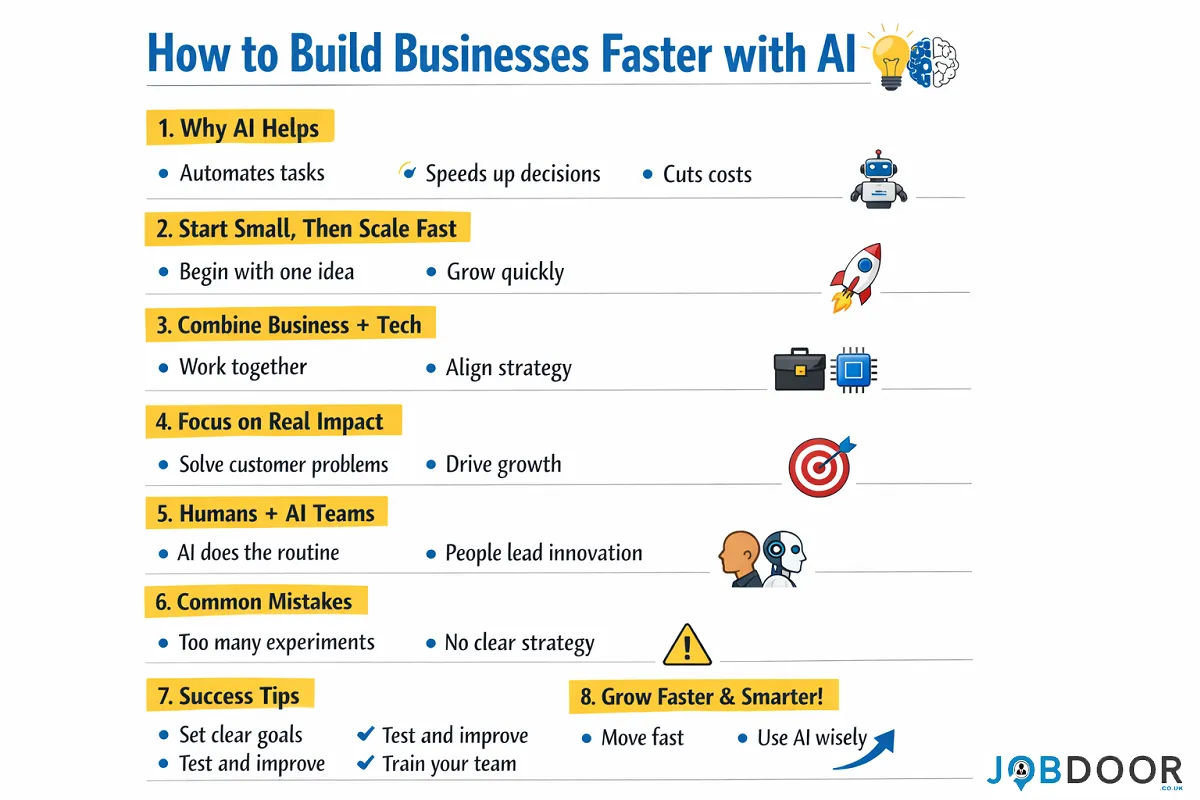
1. What is the main idea?
The article explains that AI (Artificial Intelligence) can help companies build new businesses much faster, cheaper, and smarter than before.
Earlier, starting a new business took a lot of time, money, and effort.
Now, AI is changing that.
2. Why AI makes business building faster?
AI helps in many ways:
- It automates routine work (like research, customer support, data analysis)
- It helps teams make better decisions quickly
- It reduces the need for large teams and long processes
Because of this, companies can:
- Launch products faster
- Test ideas quickly
- Fix problems early
3. What successful companies do differently?
The article says top companies don’t just “use AI tools.”
They change how they build businesses completely.
They focus on:
a) Start small, then grow fast
- Don’t try to change everything at once
- Pick one idea or area
- Build it quickly using AI
- Then expand
This approach works better than big, slow projects.
b) Combine business + technology thinking
- Business teams and tech teams must work together
- Leaders should understand both business problems and AI possibilities
c) Focus on real value (not just experiments)
Many companies fail because they:
- Try random AI experiments
- Don’t focus on actual business impact
Successful companies:
- Use AI to solve real customer problems
- Focus on revenue, growth, and efficiency
4. AI changes how companies are built:
Earlier:
- People did most work
- Processes were slow and manual
Now:
- Humans + AI work together
- AI handles repetitive tasks
- Humans focus on creativity and decisions
This creates a new type of organization, where AI becomes part of everyday work.
5. Key benefits of using AI in business building
AI helps companies:
- Build businesses faster
- Spend less money
- Scale operations easily
- Improve customer experience
- Make smarter decisions
Some AI-driven businesses even grow much faster than traditional ones.
6. Common mistakes companies make:
The article warns about a few problems:
- Using AI without a clear plan
- Running too many small experiments without results
- Not training leaders and teams properly
- Treating AI as a tool instead of a strategy
👉 Just using AI tools is not enough —
you must change how the business works.
7. What companies should do:
To succeed with AI:
- Start with a clear goal
- Use AI in important areas first
- Build small, test fast, improve quickly
- Train leaders and teams in AI
- Focus on real business results
8. Final takeaway:
AI is not just a technology upgrade.
It is a new way of building businesses.
Companies that:
- Move fast
- Learn quickly
- Use AI wisely

Python Interview Cheat Sheet: 30 Python Concepts You Should Know Before Your Next Coding Interview
Python is one of the most popular programming languages for beginners and professional developers. It is widely used in web...


AI Could Replace Millions of Entry-Level Jobs in the UK by 2035: Which Roles Are Most at Risk?
Artificial intelligence is changing the way people work across the UK. From customer service and administration to data processing and...


How to Get a Job When There Are Fewer Vacancies
Looking for a job can become much more frustrating when there are fewer vacancies available. You may be checking job...


Why Is It So Hard to Get a Job in the UK in 2026?
If you have been applying for jobs in the UK and getting very few replies, you are not alone. Many...


Entry-Level Jobs in the UK Compared: Pay, Difficulty, Stress and Career Growth
Starting your career can be confusing, especially when there are so many entry-level jobs available in the UK. While some...


Why Are Graduate Jobs Becoming Harder to Find in the UK?
Graduating from university is supposed to feel like the beginning of a new chapter. You finish your degree, prepare your...


30 Entry-Level Jobs in the UK for People With Little or No Experience
Finding your first job can feel difficult, especially when many vacancies ask for previous work experience. The good news is...


IBM Internship UK: A Complete Guide to Opportunities, Eligibility and How to Apply
An IBM internship can be an attractive opportunity for students and early-career candidates who want practical experience at a major...

Top 10 Hosting Providers for Developers
Developers assess hosting differently from most other webmasters. While absolute costs and total disk space matter, the best web hosting...


Meta and Microsoft Announce Massive Layoffs
Big tech companies like Meta Platforms and Microsoft are reducing their workforce as they spend more money on artificial intelligence...


GPT-5.5 vs Claude: Nano Banana Killer & Claude’s New Design Tool
Artificial Intelligence is evolving at an incredible pace. Every few months, new models and tools are released that push the...


Moltbook: The First Social Network for AI Agents
Artificial Intelligence is evolving rapidly. We’ve moved from simple tools to powerful AI systems that can write, design, analyze, and...


Volkswagen Uses AI Agents to Transform Its Cars in China
The automotive industry is changing faster than ever before—and at the center of this transformation is Artificial Intelligence (AI). One...


AI Is Growing Faster Than You Think
Artificial Intelligence (AI) is no longer something we only see in movies or imagine about the future. It is already...


Could AI Eliminate Humans in the Next 10 Years?
Artificial Intelligence (AI) is advancing at an incredible speed. Every day, new tools, smarter systems, and powerful technologies are being...


Meet NEO: Your New Home Robot Buddy
Imagine coming home after a long day, and instead of doing chores, managing devices, or worrying about security, everything is...


You’ve Been Using AI the Hard Way: How to Use AI Efficiently?
Artificial Intelligence is one of the most powerful tools available today. Millions of people are using AI for writing, design,...


Master AI Engineering: 20 Key Concepts Explained Simply
Artificial Intelligence (AI) is no longer a futuristic idea—it is already shaping our daily lives. From voice assistants to recommendation...


6 Ways You Are Wasting Your Time (And Don’t Even Realize It)
Time slips quietly. Not with loud warnings. Not with alarms. But in small, unnoticed habits you repeat every day. You...


How to Take Nothing Personally: 6 Powerful Ways to Protect Your Peace
Have you ever replayed a single comment in your head for hours… maybe even days? Someone said something small. Maybe...
-
 Career3 years ago
Career Opportunities for Seniors: 7 Jobs that are Perfect for Older Adults
-
 Jobs7 months ago
15 Best Second Jobs to Boost Your Income in the UK for 2026
-

 Career2 years ago
5 Free Job Posting Sites in the UK (For Employers)
-
 How-to7 months ago
How to Make Money with Google Gemini: Practical Methods Anyone Can Start
-
 How-to7 months ago
How to Build Passive Income and Wealth: 26 Lucrative Ideas
-
 AI & Tools7 months ago
10 Insane Ways Google Gemini Will Explode Your Productivity in 2026
-

 Job Description2 years ago
Support Worker Job Description: Qualifications, Skills, Salary, Working Hours
-

 AI & Tools7 months ago
ChatGPT vs Copilot: Which AI Is Best for You in 2026?