
Career
What School Won’t Teach You About Money: The Real Difference Between Poor, Middle Class, and Rich
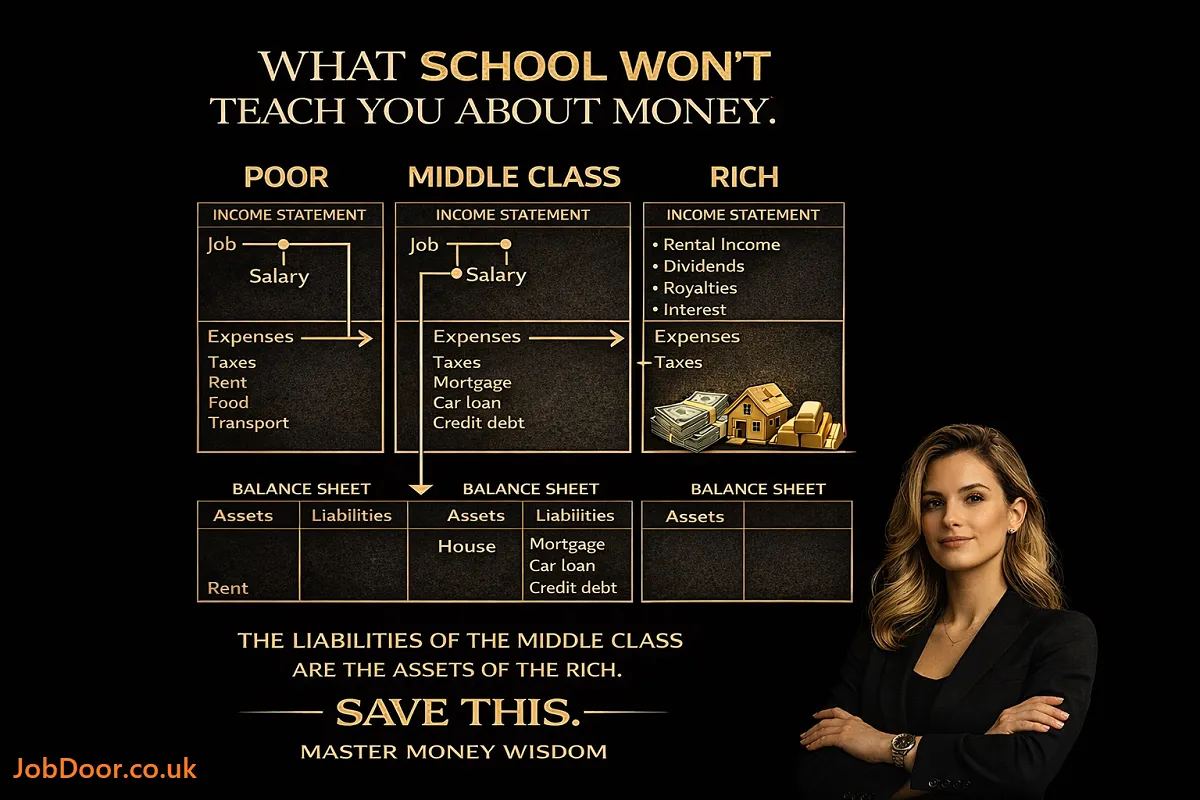
Most of us spend 12–16 years in school learning mathematics, science, and history. Yet very few of us are taught how money actually works in the real world.
The image above highlights a powerful idea: the financial habits of the poor, middle class, and rich are fundamentally different—especially in how they earn income, manage expenses, and build assets.
If you’ve ever wondered why some people stay stuck financially while others build wealth over time, this guide will break it down in simple, practical terms.
The Core Idea: Income Statement vs Balance Sheet:
Before we compare financial classes, we need to understand two basic concepts:
- Income Statement – Shows how money flows in and out (income vs expenses).
- Balance Sheet – Shows what you own (assets) and what you owe (liabilities).
We are trained to focus on income.
The wealthy focus on assets.
That’s the difference.
1. The Poor: Living on Earned Income Alone
Income Source:
- Job
- Salary
Expenses:
- Taxes
- Rent
- Food
- Transport
- Clothes
- Daily living costs
Balance Sheet:
- Little to no assets
- No significant investments
For many low-income individuals, money flows in and flows out immediately. The paycheck arrives, and it is used to survive. There is no margin to invest or save.
This isn’t about intelligence. It’s about structure.
If your income barely covers essentials, wealth-building becomes extremely difficult. The system forces a cycle:
Work → Get Paid → Spend → Repeat
There is no asset accumulation.
2. The Middle Class: Higher Income, Higher Liabilities
The middle class often earns more than the poor, but their financial structure still limits wealth growth.
Income Source:
- Job
- Salary
Expenses:
- Taxes
- Mortgage
- Car loan
- Credit card debt
- Insurance
- Lifestyle upgrades
Balance Sheet:
- Some assets (home, car)
- Many liabilities (loans, debt payments)
Here’s the critical mistake:
Many middle-class individuals believe their home and car are assets.
In reality:
- If it takes money out of your pocket every month, it is a liability.
- If it puts money into your pocket, it is an asset.
A house with a mortgage is often a liability because:
- It requires EMI payments.
- It generates no monthly income.
- It costs maintenance, taxes, and insurance.
The middle class upgrades lifestyle as income increases:
- Bigger house
- Newer car
- Better gadgets
- More subscriptions
Income rises—but so do expenses.
This creates the “golden cage”:
- High salary
- No financial freedom
3. The Rich: Income from Assets
The wealthy structure their finances differently.
Income Sources:
- Rental income
- Dividends
- Royalties
- Interest
- Businesses
- Investments
Expenses:
- Taxes
- Controlled lifestyle spending
Balance Sheet:
- Income-producing assets
- Few personal liabilities
The wealthy focus on one principle:
Buy assets that generate income.
Instead of working for money, they make money work for them.
Examples of income-producing assets:
- Rental properties
- Dividend-paying stocks
- Businesses
- Digital products
- Royalties from books or music
- Intellectual property
- Bonds
- Private equity
Their financial cycle looks like this:
Asset → Generates Income → Reinvest → Buy More Assets → Repeat
This is compounding at work.
The Powerful Statement:
“The liabilities of the middle class are the assets of the rich.”
This line explains the entire system.
When the middle class:
- Takes a mortgage
- Pays car loans
- Uses credit cards
- Pays rent
Who receives that money?
The asset owner.
For example:
- Your rent = landlord’s rental income
- Your EMI interest = bank’s profit
- Your credit card interest = financial institution revenue
The rich position themselves on the receiving side of cash flow.
Why Schools Don’t Teach This?
Traditional education prepares you to:
- Get good grades
- Get a job
- Earn a salary
It does not teach:
- Cash flow management
- Asset building
- Tax optimization
- Investing
- Entrepreneurship
- Financial psychology
Why?
Because the system was designed during the industrial era to create skilled employees—not investors.
Financial education is usually self-taught.
The Real Difference Is Mindset:
The gap between poor, middle class, and rich is not only income—it’s mindset.
Poor Mindset:
“I need a higher salary to survive.”
Middle-Class Mindset:
“I need a higher salary to afford a better life.”
Wealth Mindset:
“I need assets that generate income so I don’t depend on salary.”
This shift changes everything.
How to Start Moving Toward Wealth?
You don’t need to be rich to begin building assets.
Here’s a practical roadmap.
Step 1: Track Your Cash Flow
Know:
- How much you earn
- How much you spend
- Where your money goes
Awareness is power.
Step 2: Reduce High-Interest Debt
Credit card interest destroys wealth.
Focus on:
- Paying off high-interest loans
- Avoiding unnecessary EMI purchases
Debt reduces your ability to invest.
Step 3: Start Buying Small Assets
You don’t need real estate immediately.
Begin with:
- Index funds
- SIPs
- Dividend stocks
- Digital skills that can create side income
- Freelance services
- Online businesses
Small investments compound over time.
Step 4: Build Multiple Income Streams
Relying on one salary is risky.
Consider:
- Freelancing
- Consulting
- Blogging
- YouTube
- Investing
- Rental opportunities
- Skill-based side gigs
The goal is:
Income that doesn’t require your daily presence.
Step 5: Reinvest, Don’t Inflate Lifestyle
When income increases:
- Don’t immediately upgrade lifestyle
- Upgrade assets first
Wealth grows quietly.
The Psychological Barrier:
Many people remain middle class because they chase comfort over freedom.
- Bigger house feels successful
- Expensive car feels powerful
- Branded lifestyle feels rewarding
But financial freedom comes from:
- Ownership
- Cash flow
- Investment discipline
Delayed gratification separates wealth builders from consumers.
The Truth About Financial Freedom:
Financial freedom doesn’t mean luxury.
It means:
- Your assets pay your expenses.
- You don’t depend entirely on salary.
- You can choose how to spend your time.
The rich focus on:
Time freedom, not status symbols.
Final Takeaway:
The biggest lesson from this image is simple:
- Poor people work for money.
- Middle-class people earn more but increase liabilities.
- Rich people build assets that generate income.
If you remember only one thing, remember this:
Focus on building assets before upgrading lifestyle.
Money is not about how much you earn.
It’s about:
- How much you keep.
- How you invest it.
- Whether it works for you.
Save This Principle:
Be a student of the financial system.
Learn:
- How cash flow works
- How assets grow
- How debt traps people
- How investments compound
Schools may not teach you this—but you can teach yourself.
And once you understand the difference between income and assets, you will never see money the same way again.













How AI Is Changing Recruitment: What Job Seekers Should Expect
Artificial intelligence is changing recruitment, but not in the simple way many headlines suggest. Employers may use AI to organise...


How to Use AI to Identify Your Transferable Skills
Changing careers can feel difficult because job titles often make people focus on what they have not done instead of...

How to Use AI Responsibly When Applying for Jobs
AI can help job seekers save time when researching roles, improving a CV, preparing a cover letter and practising for...

AI Skills Every Job Seeker Should Learn (Without Becoming an AI Expert)
Artificial intelligence is becoming part of everyday work in many industries. You do not need to become a programmer, data...

How to Get a Job in the UK: A Complete Step-by-Step Guide
Finding a job in the UK can feel difficult, especially when you are competing with many other applicants. The process...

How to Write a CV With No Experience
Find out how to write a CV with no experience, what to include and how students, graduates and first-time job...


What Is a Job Description and What Should You Look For?
What is a job description? Understand what it means, what to look for and how to use it to decide...

Job Interview Preparation: Complete Guide to Before, During and After the Interview
A complete job interview preparation guide covering common questions, competency answers, remote interviews, interview mistakes and what to do after...

Sales Assistant Job Description: Duties, Skills, Salary and Career Guide UK
A Sales Assistant helps customers, processes purchases and supports the day-to-day running of a retail environment.


Web Developer Job Description: Duties, Skills, Salary and Career Guide UK
A Web Developer builds, maintains and improves websites and web applications. See the main duties, skills, qualifications, salary expectations and...

Choose an Entry-Level Job Based on Your Personality and Skills
Choosing your first job can be confusing. There are hundreds of entry-level jobs in the UK, but the best option...

How AI Can Help You Write a CV Without Making It Sound Generic
Find out how to use AI to improve your CV, tailor your experience and write clearer applications without adding false...

Python Interview Cheat Sheet: 30 Python Concepts You Should Know Before Your Next Coding Interview
Python is one of the most popular programming languages for beginners and professional developers. It is widely used in web...


AI Could Replace Millions of Entry-Level Jobs in the UK by 2035: Which Roles Are Most at Risk?
Artificial intelligence is changing the way people work across the UK. From customer service and administration to data processing and...


How to Get a Job When There Are Fewer Vacancies
Finding a job can become more difficult when fewer suitable vacancies are available. You may see the same roles repeatedly,...


How UK Job Seekers Can Use LinkedIn to Find More Job Opportunities
Use LinkedIn more effectively in your UK job search with practical advice on improving your profile, finding jobs, networking and...

Why Is It So Hard to Get a Job in the UK?
If you have been applying for jobs in the UK and getting very few replies, you are not alone. Many...


Entry-Level Jobs in the UK Compared: Pay, Difficulty, Stress and Career Growth
Starting your career can be confusing, especially when there are so many entry-level jobs available in the UK. While some...


Why Are Graduate Jobs Becoming Harder to Find in the UK?
Graduating from university is supposed to feel like the beginning of a new chapter. You finish your degree, prepare your...

Why Good Candidates Fail Job Interviews: 10 Reasons You May Not Get the Job
Find out why good candidates can fail job interviews, what may affect an employer's decision and how to improve before...
-
 Career3 years ago
Career Opportunities for Seniors: 7 Jobs that are Perfect for Older Adults
-
 Jobs8 months ago
15 Best Second Jobs to Boost Your Income in the UK for 2026
-

 Career2 years ago
5 Free Job Posting Sites in the UK (For Employers)
-
 How-to8 months ago
How to Make Money with Google Gemini: Practical Methods Anyone Can Start
-
 How-to8 months ago
How to Build Passive Income and Wealth: 26 Lucrative Ideas
-

 AI & Tools8 months ago
10 Insane Ways Google Gemini Will Explode Your Productivity in 2026
-

 Job Description2 years ago
Support Worker Job Description: Duties, Skills, Salary and Career Guide UK
-

 AI & Tools8 months ago
ChatGPT vs Microsoft Copilot: Which AI Is Best for You?