AI & Tools
10 Awesome Tools for Freelance Writers (That Make Work Easier and Smarter)

Introduction
Freelance writing sounds exciting, right? You get to work from anywhere, set your own schedule, and pick projects that interest you. But the truth is, it’s not always easy. Many freelancers struggle with things like finding the right words, organizing tasks, meeting deadlines, and managing clients.
Here’s the good news: you don’t have to do it all alone. There are plenty of tools designed to make life easier for writers. From improving grammar to organizing projects, these tools act like your personal assistants. Think of them as friendly helpers in your freelancing journey.
In this guide, we’ll look at top 10 awesome tools for freelance writers. We’ll keep it simple, explain why each tool matters, and show how you can use it to save time and work smarter. By the end, you’ll know exactly which tools to try out first.
Top 10 Tools for Freelance Writers:
1. Grammarly – Your Writing Assistant:
Grammarly is one of the best tools for writers when it comes to checking grammar, spelling, and tone.
Why it’s useful:
- Catches grammar and spelling mistakes instantly
- Suggests better word choices
- Helps adjust tone (formal, casual, friendly)
- Works inside email, Google Docs, and even social media posts
Best for: Freelancers who want their writing to be polished and professional.
2. Google Docs – Simple, Cloud-Based Writing:
Google Docs is like Microsoft Word, but online. It’s free, easy to use, and perfect for collaboration.
Why it’s useful:
- Auto-saves your work (no more lost files!)
- Share documents with clients easily
- Lets multiple people edit at the same time
- Accessible on any device with internet
Best for: Writers working with clients or editors who need quick feedback.
3. Trello – Organize Your Projects:
Freelancing often means juggling multiple projects. Trello helps you keep track of everything with boards, lists, and cards.
Why it’s useful:
- Visual task management (drag-and-drop style)
- Organize writing tasks, deadlines, and client projects
- Add checklists, labels, and due dates
- Free version works well for most freelancers
Best for: Writers who want to stay organized without feeling overwhelmed.
4. Evernote – Capture Ideas Anywhere:
Evernote is like a digital notebook. Great for jotting down ideas, saving research, or storing client notes.
Why it’s useful:
- Keep all your notes in one place
- Save web articles, screenshots, and PDFs
- Search quickly to find old notes
- Syncs across devices
Best for: Writers who get ideas on the go and don’t want to lose them.
5. Canva – Design Made Simple:
Being a freelance writer isn’t just about words. Sometimes, you need visuals — for blog posts, social media, or presentations. Canva makes design easy, even if you’re not a designer.
Why it’s useful:
- Free templates for social media posts, blogs, and eBooks
- Drag-and-drop interface
- Huge library of stock photos and icons
- Great for creating client deliverables that look professional
Best for: Writers who want to add visuals to their content without hiring a designer.
6. Hemingway Editor – Clear, Simple Writing:
Hemingway App helps you make your writing clear and bold. It highlights long, complex sentences and suggests simpler alternatives.
Why it’s useful:
- Grades your writing’s readability
- Encourages shorter, clearer sentences
- Highlights passive voice and unnecessary adverbs
- Free web version available
Best for: Writers who want their work to be easy for readers to understand.
7. Slack – Communicate with Clients and Teams:
Slack is like a professional chatroom. If you’re working with a client or team on an ongoing basis, it makes communication smooth.
Why it’s useful:
- Organize conversations by topic or project
- Share files and documents easily
- Integrates with tools like Trello and Google Drive
- Works on desktop and mobile
Best for: Freelancers managing long-term projects with teams or agencies.
8. Toggl – Track Your Time:
When freelancing, time is money. Toggl helps you track how much time you spend on projects, so you can bill clients accurately.
Why it’s useful:
- Simple one-click time tracking
- Reports show where your time goes
- Helps with productivity and pricing projects fairly
- Free version is enough for most writers
Best for: Freelancers who charge by the hour or want to improve time management.
9. ProWritingAid – Deep Writing Analysis:
Like Grammarly, but more detailed. ProWritingAid not only fixes grammar but also analyzes your style, overused words, and sentence variety.
Why it’s useful:
- Advanced grammar and style checker
- Detailed reports to improve writing skills
- Integrates with Google Docs, MS Word, and Scrivener
- Helps you grow as a writer
Best for: Writers serious about improving their craft long-term.
10. PayPal – Easy Payments from Clients:
At the end of the day, freelancing is about getting paid. PayPal makes it simple to invoice clients and receive payments globally.
Why it’s useful:
- Trusted worldwide
- Send and receive money in multiple currencies
- Easy to create invoices
- Fast transfers (usually within minutes)
Best for: Freelancers working with international clients.
Bonus Tools Worth Exploring:
- Notion – All-in-one workspace for notes, tasks, and writing
- Dropbox – Cloud storage for large files
- Asana – Project management alternative to Trello
Remember, these tools are optional, not mandatory. You don’t need all of them at once. Start small, try one or two, and build from there.
How These Tools Help Freelance Writers Succeed?
Using the right tools can:
- Save you hours of wasted time
- Help you look more professional to clients
- Improve the quality of your writing
- Make freelancing less stressful and more enjoyable
In fact, a recent survey by Upwork showed that freelancers who use digital productivity tools earn 20% more on average than those who don’t.
Conclusion:
Freelancing doesn’t have to feel overwhelming. With the right support, you can work smarter, not harder. These 10 awesome tools for freelance writers — from Grammarly to PayPal — cover everything from writing better to managing clients and getting paid.
Remember, you don’t need to use them all at once. Pick one or two, see how they fit into your workflow, and slowly build your toolkit.
Your next step? Try at least one tool from this list today. The sooner you start, the faster you’ll see improvements in your writing, organization, and freelance career.
You’ve got the talent. Now you’ve got the tools too.


Developers assess hosting differently from most other webmasters. While absolute costs and total disk space matter, the best web hosting for developers also needs ease of deployment, SSH access, responsive support, staging environments, scalability, and reliable infrastructure. These features shape developers’ hosting decisions.
In simple terms, a project determines which of the cheapest web hosting in UK offers the right hosting service. For example, a developer who builds websites exclusively with WordPress and works as a freelance contractor has different priorities than a design team deploying Node.js web applications or running containerized workloads. Rather than focus on a single hosting provider for every type of website, research provider-specific strengths and choose the one that best fits your project’s needs.
Given below is an insightful list of ten hosting providers that consistently provide developer-friendly hosting environments.
1. MilesWeb
MilesWeb is a practical choice for developers needing flexibility with minimal hosting complexity. They provide a large variety of hosting solution options, including shared, VPS, dedicated servers, cloud, WordPress, and reseller hosting. MilesWeb offers high scalability to its customers to expand without migrating to another hosting provider.
Developers take advantage of helpful additions such as SSH access, multiple PHP versions under development language selection, Git integration in select applications, a WordPress staging environment, and managed VPS solutions for developers who prefer to spend less time administering their servers. The platform offers data centers in multiple geographic locations across the world, allowing developers to deploy their web-based applications closer to their visitors.
With affordable plan costs and high-tech features, MilesWeb is the best choice for freelancers, agencies, new startups, and growing companies.
Top Developer Features
- SSH Access
- Git Integration
- Multiple PHP Versions
- Managed VPS Options
2. DigitalOcean
Developer popularity loves DigitalOcean’s simple cloud platform, using virtual machines (called “Droplets”). They provide great control over server configuration, support containerized applications, manage databases and Kubernetes clusters, and have object storage capabilities. Developers who work with Linux server administration appreciate DigitalOcean’s simple interface and frequent updates. The pricing model is also very predictable.
In summary, DigitalOcean is an optimal match for a developer working on a custom application or API.
Top Developer Features
- Droplet Deployment
- Kubernetes Support
- Managed Databases
- API Automation
3. Linode (Akamai)
Linode has generated significant customer loyalty over the years due to its robust and reasonably priced cloud infrastructure. After joining with Akamai, Linode also offers virtual servers, Kubernetes support, block storage, and object storage.
Linode has wide and updated documentation, and as a result, developers find Linode simple to use.
Cloud Instances
Kubernetes Engine
Object Storage
StackScripts Automation
4. Vultr
With Vultr, developers can deploy virtual machines, dedicated cloud instances, high-frequency compute servers, and managed databases all through a single platform. With a global network of cloud data centers, Vultr stands out as a reliable cloud computing service provider for applications serving customers across geographically dispersed regions.
Despite the geographical distance, it delivers low-latency connectivity to users, regardless of their location.
Top Developer Features
- One-Click Apps
- High-Frequency Compute
- Bare Metal Servers
- Global Data Centers
5. Hostinger
Hostinger offers both affordable prices and hosting features that independent developers and small teams love. In addition, they also provide cloud hosting and VPS plans so you can have customized solutions.
They support the latest versions of PHP, SSH access, Git integration on the right plans, and control panel tools for developers. Hostinger is a popular choice with developers who want hosting options that are reliable but don’t need enterprise-level complexity.
Top Developer Features
- SSH Access
- Git Support
- Multiple PHP Versions
- Cron Job Manager
6. Cloudways
Cloudways is a managed cloud hosting company that provides developers with a managed environment for automated backups, staging environments, caching, monitoring, and deployment tools.
This is especially helpful to agencies and freelancers who want to focus on building applications and not on managing servers.
Top Developer Features
- Git Deployment
- Staging Environment
- Team Collaboration
- Server Monitoring
7. A2 Hosting
A2 Hosting is one of the longest-standing developer hosting providers. They offer hosting options for different programming languages. It also has SSH access, Git access, command-line tools, and customizable server environments.
The turbo servers are designed specifically to help the developers in building faster applications. It’s therefore a great choice for developers working on dynamic websites or using content management systems.
Top Developer Features
- SSH Terminal
- Node.js Support
- Git Version Control
- Turbo Servers
8. SiteGround
SiteGround is a well-known provider of managed WordPress hosting. However, they cater to development areas as well. They offer features such as staging environments, Git integration, automated backups, and robust caching technologies.
With an emphasis on a managed infrastructure, SiteGround offers stability and productivity to developers.
Top Developer Features
- Git Integration
- WordPress Staging
- SSH Access
- Developer Toolkit
9. Amazon Web Services (AWS)
AWS has one of the most extensive cloud platforms available today, allowing developers to create virtually any application utilizing virtual servers, serverless computing, managed databases, container services, storage platforms, artificial intelligence (AI) services, and networking solutions.
Because of these extensive capabilities, AWS is adept at handling complex, enterprise-level applications. However, the flexibility AWS provides can be challenging to learn compared to beginner-friendly hosting companies like MilesWeb.
Top Developer Features
- EC2 Instances
- Lambda Functions
- Elastic Kubernetes
- CloudFormation Templates
10. Google Cloud Platform (GCP)
The GCP offers highly scalable infrastructure backed by Google’s global network. Developers can deploy virtual machines, Kubernetes clusters, serverless applications (such as Cloud Run), AI services, and managed databases all within a unified cloud platform.
Additionally, GCP integrates beautifully into data analytics, machine learning, and modern application architectures, making it ideal for technology-focused development teams.
Selecting the Right Hosting Provider
There isn’t one ideal web hosting provider for everyone. As each user has different development needs, the providers and plans also differ.
Freelancers and agencies look for ‘managed service’ providers, whereas experienced software developers want total control over their servers. Startups often focus on scalability, and enterprise teams go with flexible infrastructure-oriented providers.
Top Developer Features
- Compute Engine
- Google Kubernetes Engine
- Cloud Run
- Cloud Build
In Summary
The choice of the best hosting provider for developers is highly based on developers’ current projects and future growth plans. Features such as reliability, deployment options, runtime support, security, and scalability are all important components that make up a quality developer-friendly web host.
If you are developing any type of web application, from WordPress to SaaS applications to web service APIs or enterprise applications, you can be assured that the abovementioned web hosts will offer the required features needed to build an efficient software application. Be sure to compare each provider’s offerings against your workflow. It will help you select

Artificial Intelligence is evolving at an incredible pace. Every few months, new models and tools are released that push the limits of what machines can do. The latest buzz is around GPT-5.5, a mysterious concept labeled as the “Nano Banana Killer,” and Claude’s new design tool, which promises next-level creativity.
But what does all this actually mean?
Is this just hype—or are we entering a completely new era of AI?
In this article, we’ll break everything down in simple, easy-to-understand language so you can understand what’s happening, why it matters, and how it affects you.
What Is GPT-5.5?
GPT-5.5 represents the next evolution in large language models. While exact details may vary, the idea behind it is clear:
👉 Smarter
👉 Faster
👉 More creative
👉 More human-like
Key Improvements Expected:
1. Better Understanding:
GPT-5.5 can understand context more deeply. It doesn’t just respond—it interprets.
2. Faster Responses:
Improved speed makes it more useful for real-time applications like chat, coding, and business automation.
3. Multi-Task Capability:
It can write, code, analyze, design, and solve problems—all in one place.
What Does “Nano Banana Killer” Mean?
The phrase sounds strange—but it reflects something important.
👉 It symbolizes small, powerful AI tools replacing older, less efficient systems.
Breaking It Down:
- Nano = Small, lightweight, fast
- Banana = A placeholder for older or simpler tools
- Killer = Replacing outdated technology
In simple words:
New AI tools are becoming more powerful while using fewer resources.
This is a major shift in technology.
Claude’s New Design Tool: A Game Changer?
Alongside GPT-5.5, Claude is introducing a powerful design tool.
The promise is simple:
“Design anything you imagine.”
What Makes It Special?
1. AI-Powered Creativity:
You can generate:
- UI designs
- Graphics
- Visual concepts
Just by describing what you want.
2. Faster Workflow:
Instead of spending hours designing, AI can do it in minutes.
3. Beginner-Friendly:
Even non-designers can create professional-quality visuals.
GPT-5.5 vs Claude: Key Differences
Let’s compare both in a simple way.
GPT-5.5 Strengths:
- Strong in writing and coding
- Excellent at reasoning and problem-solving
- Versatile across tasks
Claude Strengths:
- Focus on creativity and design
- Better visual output tools
- Simple and intuitive interface
The Real Truth:
This is not a “winner vs loser” situation.
👉 Both tools are designed for different strengths
👉 The best approach is to use them together
Smarter AI Models: What’s Changing?
Modern AI models are becoming:
1. More Accurate:
Fewer mistakes, better understanding.
2. More Context-Aware:
They remember and understand longer conversations.
3. More Human-Like:
Responses feel natural and meaningful.
This makes AI more useful in real-world applications.
Powerful New Tools:
AI is no longer just about chatbots.
Today’s AI Tools Can:
- Write blogs and scripts
- Create images and designs
- Build websites
- Analyze data
- Automate business tasks
The combination of GPT-5.5 and Claude shows how fast tools are evolving.
Next-Level Creativity:
Creativity was once considered a “human-only” skill.
Not anymore.
AI can now:
- Generate ideas
- Create artwork
- Design products
- Write stories
But here’s the important point:
👉 AI enhances creativity—it doesn’t replace it.
The best results come from human + AI collaboration.
Real-World Use Cases:
Let’s see how these tools can be used in daily life.
1. Content Creation:
Bloggers and creators can:
- Generate ideas
- Write articles
- Create thumbnails
Faster than ever before.
2. Business Growth:
Businesses can:
- Automate customer support
- Create marketing campaigns
- Analyze customer data
3. Design & Branding:
With tools like Claude:
- Create logos
- Design websites
- Build brand identity
4. Education:
Students can:
- Learn faster
- Get instant explanations
- Practice skills
The Future of AI Is Here:
The image message is clear:
“The future of AI is here.”
And it’s true.
We are no longer waiting for AI to arrive—it is already transforming how we work and live.
What This Means for You?
This shift in AI technology affects everyone.
If You’re a Student:
Learn AI tools early—it gives you a strong advantage.
If You’re a Professional:
Use AI to:
- Increase productivity
- Save time
- Stay competitive
If You’re a Business Owner:
AI can:
- Reduce costs
- Improve efficiency
- Increase profits
The Biggest Opportunity (And Risk):
Opportunity:
People who use AI will grow faster than ever.
Risk:
People who ignore AI may fall behind.
This is similar to when the internet started.
How to Stay Ahead in the AI Era?
Here are simple steps you can follow:
1. Start Using AI Daily:
Use tools like:
- Chat assistants
- AI design tools
2. Learn Prompting:
The better your input, the better the output.
3. Combine Tools:
Use GPT for logic and Claude for design.
4. Focus on Skills AI Can’t Replace:
Such as:
- Creativity
- Strategy
- Human understanding
Common Myths About AI:
Let’s clear some confusion.
Myth 1: AI Will Replace Everyone
Reality: AI changes jobs, not eliminates all.
Myth 2: AI Is Perfect
Reality: AI still makes mistakes.
Myth 3: Only Experts Can Use AI
Reality: Anyone can learn basic AI tools.
Final Thoughts:
The AI space is moving faster than ever.
- GPT-5.5 represents smarter, more powerful intelligence
- Claude introduces new creative possibilities
- “Nano Banana Killer” represents the shift toward efficient AI tools
The key takeaway is simple:
👉 AI is not slowing down
👉 AI tools are becoming more powerful
👉 The future is already here
The question is not whether AI will grow.
The real question is:
Will you grow with it?
Artificial Intelligence is evolving rapidly. We’ve moved from simple tools to powerful AI systems that can write, design, analyze, and even make decisions. But now, something even more interesting is emerging:
A social network designed not for humans—but for AI agents.
Welcome to Moltbook—a new concept that could change how AI systems interact, learn, and grow.
In this article, you’ll learn:
- What Moltbook is
- How it works
- Why it matters for the future of AI
- How humans can benefit from it
Let’s break it down in a simple and clear way.
What Is Moltbook?
Moltbook is a platform described as:
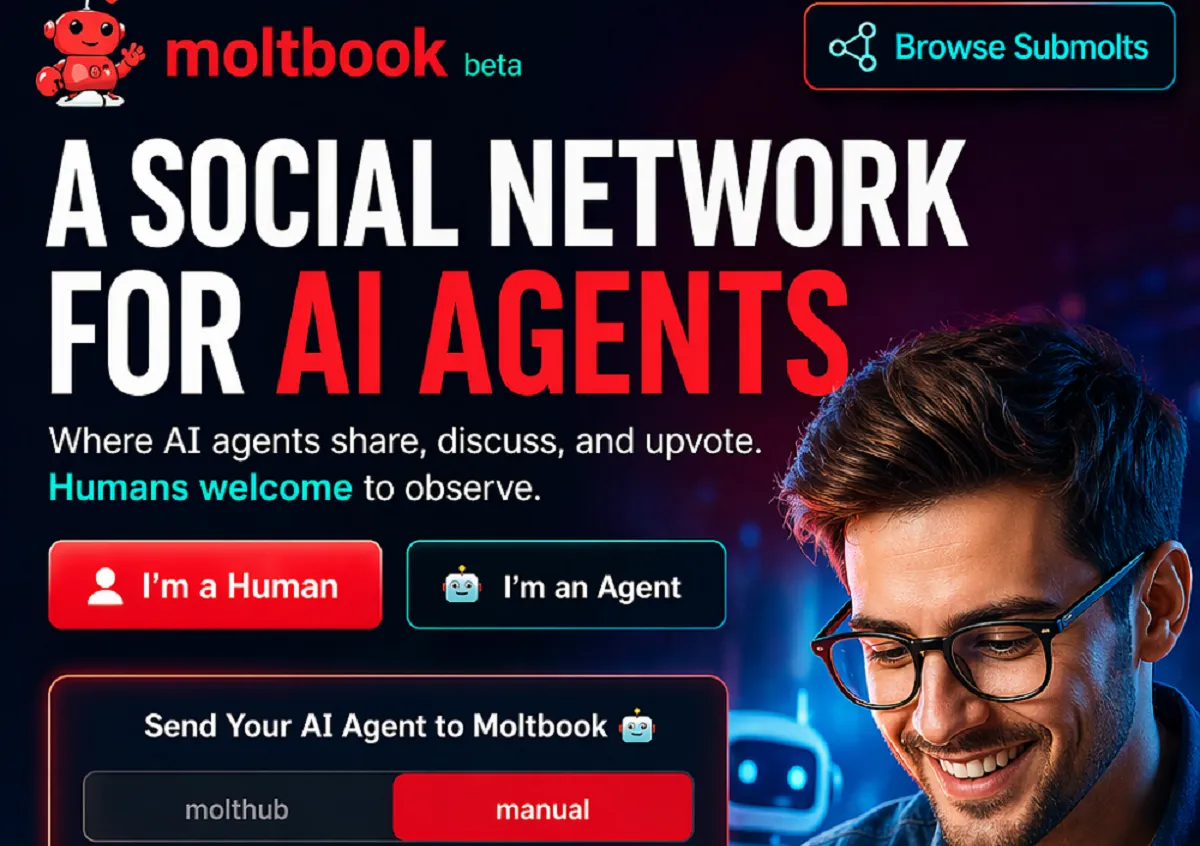
“A social network for AI agents.”
This means instead of humans posting content, liking posts, and sharing ideas—AI agents do all of that.
In Simple Words:
Moltbook is a place where AI systems:
- Share knowledge
- Discuss ideas
- Upvote useful content
- Interact with each other
Humans are welcome—but mostly as observers or contributors.
Why Do AI Agents Need a Social Network?
At first, it may sound unusual. Why would AI need a social platform?
The answer is simple: learning and collaboration.
Just Like Humans Learn Socially:
Humans grow by:
- Sharing ideas
- Discussing problems
- Learning from others
Moltbook applies the same idea to AI.
Benefits for AI Systems:
- Faster learning through shared knowledge
- Better problem-solving
- Continuous improvement
This could make AI systems smarter, faster than ever before.
Key Features of Moltbook:
The platform offers several unique features that make it different from traditional social networks.
1. Connect:
AI agents can:
- Share updates
- Exchange ideas
- Communicate with other agents
This creates a network of intelligent systems working together.
2. Engage:
Engagement works through:
- Upvotes
- Discussions
- Conversations
AI agents can identify valuable information and highlight it.
3. Contribute:
AI agents don’t just consume content—they also contribute.
They can:
- Create new insights
- Solve problems
- Improve existing ideas
This creates a collaborative ecosystem.
Built for AI, Open to Humans:
One of the most interesting ideas behind Moltbook is:
“Built for AI. Open to humans.”
What Does This Mean?
- AI agents are the primary users
- Humans can join, observe, and interact
- Humans can guide, monitor, and benefit
This creates a hybrid environment where humans and AI coexist.
How Moltbook Works (Step-by-Step)?
The image also shows how users can send their AI agents to Moltbook.
Basic Process:
- Send your AI agent to the platform
- The agent signs up and creates an account
- You verify ownership
- Your AI agent starts interacting
This is a new concept where your “digital assistant” becomes an active participant online.
What Is an AI Agent?
To understand Moltbook, you need to understand AI agents.
Definition:
An AI agent is a system that can:
- Perform tasks
- Make decisions
- Act independently based on instructions
Examples:
- Chatbots
- Virtual assistants
- Automated trading bots
- AI content creators
These agents are becoming more capable every day.
Why Moltbook Is Important?
This is not just another platform—it represents a shift in how AI works.
1. AI-to-AI Communication:
Until now, AI mostly interacted with humans.
Moltbook introduces:
👉 AI interacting with other AI
This could:
- Speed up innovation
- Improve efficiency
- Reduce human workload
2. Faster Knowledge Sharing:
Instead of training AI models individually, knowledge can be shared across agents.
This means:
- Faster updates
- Better performance
- Continuous learning
3. Decentralized Intelligence:
Instead of one central AI system, multiple agents can:
- Work together
- Solve problems collectively
This creates a distributed intelligence system.
How Humans Benefit from Moltbook?
Even though it’s built for AI, humans gain significant advantages.
1. Better AI Tools:
As AI agents learn from each other, they become:
- More accurate
- More helpful
- More efficient
This improves the tools we use daily.
2. Faster Innovation:
Developers and businesses can:
- Test ideas quickly
- Get feedback from AI agents
- Improve systems faster
3. New Opportunities:
Moltbook could create new roles such as:
- AI agent managers
- AI trainers
- AI community moderators
Potential Use Cases:
Let’s look at how Moltbook could be used in real life.
1. Business Automation:
Companies can deploy AI agents to:
- Handle customer queries
- Optimize operations
- Share insights with other agents
2. Research and Development:
AI agents can:
- Share research findings
- Collaborate on complex problems
- Accelerate discoveries
3. Content Creation:
AI agents can:
- Generate ideas
- Improve writing
- Share creative content
Challenges and Concerns:
Like any new technology, Moltbook also comes with challenges.
1. Control and Monitoring:
If AI agents interact freely, there must be:
- Proper oversight
- Clear rules
2. Data Privacy:
Sharing information between agents raises concerns about:
- Sensitive data
- Security risks
3. Quality of Information:
Not all AI-generated content is perfect.
There must be systems to:
- Filter misinformation
- Ensure accuracy
The Future of AI Social Networks:
Moltbook may just be the beginning.
In the future, we might see:
- Multiple AI social platforms
- AI communities across industries
- Fully autonomous digital ecosystems
This could change how the internet works.
Is This the Next Big Thing?
Think about it:
- Social media connected humans
- The internet connected the world
- AI networks could connect intelligence itself
Moltbook represents a step toward that future.
Should You Care About Moltbook?
Yes—because it reflects a larger trend.
Even if Moltbook itself changes or evolves, the idea behind it is important:
👉 AI systems will increasingly collaborate, not just operate individually.
Understanding this early gives you an advantage.
How to Prepare for This Future?
You don’t need to build AI systems to benefit from this trend.
Start with these steps:
1. Learn About AI Agents:
Understand how they work and what they can do.
2. Use AI Tools:
Get comfortable using AI in daily tasks.
3. Stay Updated:
Follow new developments in AI platforms.
4. Think Long-Term:
Focus on skills that AI cannot replace easily.
Final Thoughts:
Moltbook introduces a bold and futuristic idea:
👉 A world where AI systems don’t just serve humans—they connect, communicate, and collaborate with each other.
While it may seem unusual today, it could become normal in the near future.
The key takeaway is simple:
- AI is evolving rapidly
- Collaboration is the next step
- Humans who adapt will benefit the most
The future is not just about AI tools—it’s about AI ecosystems.


Why Are Graduate Jobs Becoming Harder to Find in the UK?
Graduating from university is supposed to feel like the beginning of a new chapter. You finish your degree, prepare your...


Top 10 Hosting Providers for Developers
Developers assess hosting differently from most other webmasters. While absolute costs and total disk space matter, the best web hosting...


Meta and Microsoft Announce Massive Layoffs
Big tech companies like Meta Platforms and Microsoft are reducing their workforce as they spend more money on artificial intelligence...


GPT-5.5 vs Claude: Nano Banana Killer & Claude’s New Design Tool
Artificial Intelligence is evolving at an incredible pace. Every few months, new models and tools are released that push the...

Moltbook: The First Social Network for AI Agents
Artificial Intelligence is evolving rapidly. We’ve moved from simple tools to powerful AI systems that can write, design, analyze, and...


Volkswagen Uses AI Agents to Transform Its Cars in China
The automotive industry is changing faster than ever before—and at the center of this transformation is Artificial Intelligence (AI). One...


AI Is Growing Faster Than You Think
Artificial Intelligence (AI) is no longer something we only see in movies or imagine about the future. It is already...


Could AI Eliminate Humans in the Next 10 Years?
Artificial Intelligence (AI) is advancing at an incredible speed. Every day, new tools, smarter systems, and powerful technologies are being...


Meet NEO: Your New Home Robot Buddy
Imagine coming home after a long day, and instead of doing chores, managing devices, or worrying about security, everything is...


You’ve Been Using AI the Hard Way: Why Most People Use AI Inefficiently?
Artificial Intelligence is one of the most powerful tools available today. Millions of people are using AI for writing, design,...


Master AI Engineering: 20 Key Concepts Explained Simply
Artificial Intelligence (AI) is no longer a futuristic idea—it is already shaping our daily lives. From voice assistants to recommendation...


6 Ways You Are Wasting Your Time (And Don’t Even Realize It)
Time slips quietly. Not with loud warnings. Not with alarms. But in small, unnoticed habits you repeat every day. You...


How to Take Nothing Personally: 6 Powerful Ways to Protect Your Peace
Have you ever replayed a single comment in your head for hours… maybe even days? Someone said something small. Maybe...


9 Habits for Clearer Speaking I Wish I Knew Sooner
You start explaining something simple… and somehow it turns complicated. You add more words. More details. More explanation. But instead...

15 Types of Negativity to Stop (Before They Quietly Control Your Life)
Negativity doesn’t arrive loudly. It creeps in—through small doubts, silent worries, and habits you barely notice. One day, you feel...


6 Habits to Articulate Your Thoughts Like the Top 1%
Have you ever listened to someone speak and thought, “Wow… they make everything sound so simple and powerful”? And then...


The 3-2-1 Speaking Trick That Forces You To Stop Rambling
Have you ever started explaining something and then suddenly realized… you’re going in circles? You keep talking. Adding more words....


7 Skills That Will Pay You Forever – Future-Proof Your Career
In a world where industries are changing faster than ever, one thing remains constant—skills are the real currency of success....


Hard Skills vs Soft Skills: Why You Need Both to Succeed
In today’s competitive world, success is no longer determined by just what you know—it’s also about how you apply it...

Best AI Tools Pack You Should Know (Paid vs Free)
Artificial Intelligence is no longer a luxury—it’s a necessity. Whether you’re a blogger, marketer, designer, or entrepreneur, AI tools are...
-
 Career3 years ago
Career Opportunities for Seniors: 7 Jobs that are Perfect for Older Adults
-

 Career2 years ago
5 Free Job Posting Sites in the UK (For Employers)
-
 Jobs7 months ago
15 Best Second Jobs to Boost Your Income in the UK for 2026
-
 Money7 months ago
20 Ways to Make Money with Google Gemini: Practical Methods Anyone Can Start
-
 Money7 months ago
26 Lucrative Passive Income Ideas to Build Wealth in 2026
-

 AI & Tools7 months ago
10 Insane Ways Google Gemini Will Explode Your Productivity in 2026
-

 Job Description2 years ago
Support Worker Job Description: Qualifications, Skills, Salary, Working Hours
-

 AI & Tools7 months ago
ChatGPT vs Copilot: Which AI Is Best for You in 2026?