
News
Why UK Ranked Second-Most Miserable Country in Global Mental Health Survey?


In a recent global mental health survey conducted by Sapien Labs, the United Kingdom was ranked as the second-most miserable country. This shocking revelation has left many wondering what the reasons behind this mystery could be. So, we thought of writing this article, to throw some light into the factors contributing to the UK’s high ranking in the mental health survey. Let’s begin!
Lack of Access to Mental Health Services:
First and far most the primary reasons for the UK’s poor ranking in the global mental health survey is the lack of access to mental health services. Despite efforts to improve mental health awareness and resources, many individuals in the UK still struggle to access quality mental health care. Long waiting times, limited availability of therapists, and stigma surrounding mental health issues all contribute to the challenges faced by those seeking help.
High Levels of Stress and Anxiety:
Another key factor is the high levels of stress and anxiety experienced by Britons. The fast-paced nature of modern life, economic uncertainty, and societal pressures all play a role in exacerbating stress levels. This stress can lead to anxiety, depression, and other mental health issues if left untreated.
Impact of Social Isolation and Loneliness:
Next are the social isolation and loneliness, these are two most significant contributors to the UK’s mental health challenges. Despite being more connected digitally on social media and TikTok, many Britons in the UK report feeling isolated and lonely.
The study revealed that 37% of participants expressed feeling either very or fairly lonely in the present, while 59% reported feeling not very lonely or not lonely at all. Interestingly, the percentage of individuals experiencing loneliness rises to 58% among those in the 18-24 age group. The lack of meaningful social connections can take a toll on mental well-being, leading to feelings of depression and despair.
Influence of Economic Factors:
Economic factors also play a role in the UK’s mental health crisis. Income inequality, job insecurity, and financial stress can all contribute to poor mental health outcomes. Individuals who struggle to make ends meet or fear losing their livelihoods may experience heightened levels of anxiety and depression.
Stigma and Lack of Awareness:
Stigma surrounding mental health issues and a lack of awareness also contribute to the UK’s mental health challenges. Many individuals still feel ashamed or embarrassed to seek help for mental health issues, leading to underreporting and undertreatment. Increased education and awareness campaigns are needed to break down the stigma and encourage individuals to prioritize their mental well-being.
The Importance of Taking Action:
While the UK’s ranking in the global mental health survey is concerning, there is hope for improvement. By addressing the factors contributing to poor mental health outcomes and increasing access to quality mental health services, the UK can work towards a brighter future for its residents. It is essential for individuals, communities, and policymakers to come together to prioritize mental health and well-being for all.


Big tech companies like Meta Platforms and Microsoft are reducing their workforce as they spend more money on artificial intelligence (AI).
Meta has decided to cut about 8,000 jobs, which is around 10% of its employees. The company also said it will not fill about 6,000 open job positions. These changes are expected to start from May 20.
At the same time, Microsoft is taking a different approach. Instead of direct layoffs, it is offering voluntary buyouts to its employees in the United States. Around 7% of its US workforce, which is about 8,750 employees, may choose to leave with compensation.
The main reason behind these decisions is AI investment. Both companies are spending billions of dollars on building AI systems, data centers, and new technology. To manage these high costs, they are trying to reduce other expenses, including employee costs.
This shows a bigger trend in the tech industry. Companies are not necessarily struggling financially, but they are changing their priorities. They are moving money and resources from traditional jobs to AI development.
In simple terms, companies are becoming more focused on AI, and this is leading to fewer job opportunities in some areas, especially where AI can do the work faster or more efficiently.

The automotive industry is changing faster than ever before—and at the center of this transformation is Artificial Intelligence (AI). One of the biggest moves in this space comes from Volkswagen, which is now using AI agents to enhance and customize its cars for the Chinese market.
This is not just another tech upgrade. It represents a major shift in how cars are designed, built, and experienced by users.
In this detailed guide, we’ll break down:
- What AI agents are
- Why Volkswagen is using them
- How they improve cars
- What this means for the future of driving
What Are AI Agents in Cars?
AI agents are intelligent software systems that can:
- Analyze data
- Make decisions
- Learn from user behavior
In cars, these agents act like a smart brain that controls various features and adapts to the driver.
Unlike traditional software, AI agents don’t just follow instructions—they learn and improve over time.
Why Volkswagen Is Focusing on China?
China is the world’s largest automotive market, and it is also one of the most advanced when it comes to technology adoption.
Key Reasons:
1. Tech-Savvy Consumers:
Chinese customers expect:
- Smart features
- Seamless digital experiences
- Advanced connectivity
2. Strong Competition:
Local brands are already using AI aggressively. To stay competitive, Volkswagen needs to innovate.
3. Fast Innovation Cycle:
China moves quickly in terms of tech upgrades. AI helps Volkswagen keep up with this pace.
AI-Powered Design: A New Era of Car Development:
Traditional car design takes years. AI changes that completely.
How AI Helps:
- Analyzes user preferences
- Predicts market trends
- Optimizes design features
This leads to:
- Faster development
- Better user experience
- More efficient production
AI allows Volkswagen to design cars that people actually want—before they even ask for them.
Tailored for China: Hyper-Personalization
One of the most powerful aspects of AI is personalization.
Volkswagen is using AI agents to create cars specifically designed for Chinese users.
Examples:
- Language and voice assistants in local dialects
- Customized infotainment systems
- Features based on driving habits
This approach ensures that cars are not just global products—they are locally relevant.
Smarter Decisions in Real Time:
AI agents can process huge amounts of data instantly.
What This Means for Drivers:
- Real-time traffic analysis
- Route optimization
- Safety alerts
- Predictive maintenance
Instead of reacting to problems, AI helps prevent them.
Faster Than Ever: Speed and Efficiency
AI significantly reduces the time required for:
- Designing cars
- Testing features
- Launching updates
Over-the-Air Updates:
Cars can now receive updates just like smartphones.
This means:
- New features without buying a new car
- Improved performance over time
- Continuous innovation
How AI Improves the Driving Experience?
AI agents are not just about technology—they are about better driving experiences.
1. Smart Assistance:
Cars can understand voice commands and respond naturally.
2. Predictive Features:
AI learns your habits:
- Preferred routes
- Driving style
- Climate settings
3. Enhanced Safety:
AI can detect risks and warn drivers in advance.
4. Personalized Comfort:
Your car adjusts automatically to your preferences.
AI in Automotive: A Bigger Trend
Volkswagen is not alone. The entire automotive industry is moving towards AI.
Industry Trends:
- Self-driving technology
- Connected vehicles
- Smart dashboards
- AI-powered maintenance
Cars are becoming intelligent systems, not just machines.
Benefits of AI in Cars:
Let’s summarize the key advantages:
1. Better User Experience
More intuitive and personalized features.
2. Increased Safety
Real-time alerts and predictive systems.
3. Cost Efficiency
Reduced maintenance and optimized performance.
4. Continuous Improvement
Regular updates keep the car modern.
Challenges of AI in Cars:
Despite its benefits, AI also brings challenges.
1. Data Privacy
Cars collect a lot of user data. Protecting it is crucial.
2. System Reliability
AI must be accurate and dependable.
3. High Costs
Advanced technology can increase car prices.
4. Regulation Issues
Different countries have different rules for AI usage.
What This Means for the Future of Cars?
The message is clear:
AI is shaping the future of automotive.
In the coming years, we can expect:
- Fully autonomous vehicles
- Smarter in-car assistants
- More connected ecosystems
- Highly personalized driving experiences
Cars will become more like smart companions rather than just vehicles.
What It Means for Consumers?
If you are planning to buy a car in the future, AI will play a big role in your decision.
Things to Look For:
- Smart features
- AI-based safety systems
- Update capabilities
- Personalization options
The value of a car will not just depend on its engine—but on its intelligence.
What It Means for Jobs?
AI in the automotive industry will also impact jobs.
New Opportunities:
- AI engineers
- Data scientists
- Software developers
Changing Roles:
- Traditional mechanical jobs may evolve
- More focus on digital skills
The industry is shifting from hardware to software.
Final Thoughts:
Volkswagen’s move to use AI agents in its Chinese cars is a strong signal of where the industry is heading.
It shows that:
- AI is becoming essential
- Personalization is the future
- Speed and innovation are key
The automotive world is entering a new era—one where cars are intelligent, adaptive, and deeply connected.
If you want to stay ahead, it’s important to understand and embrace this change.
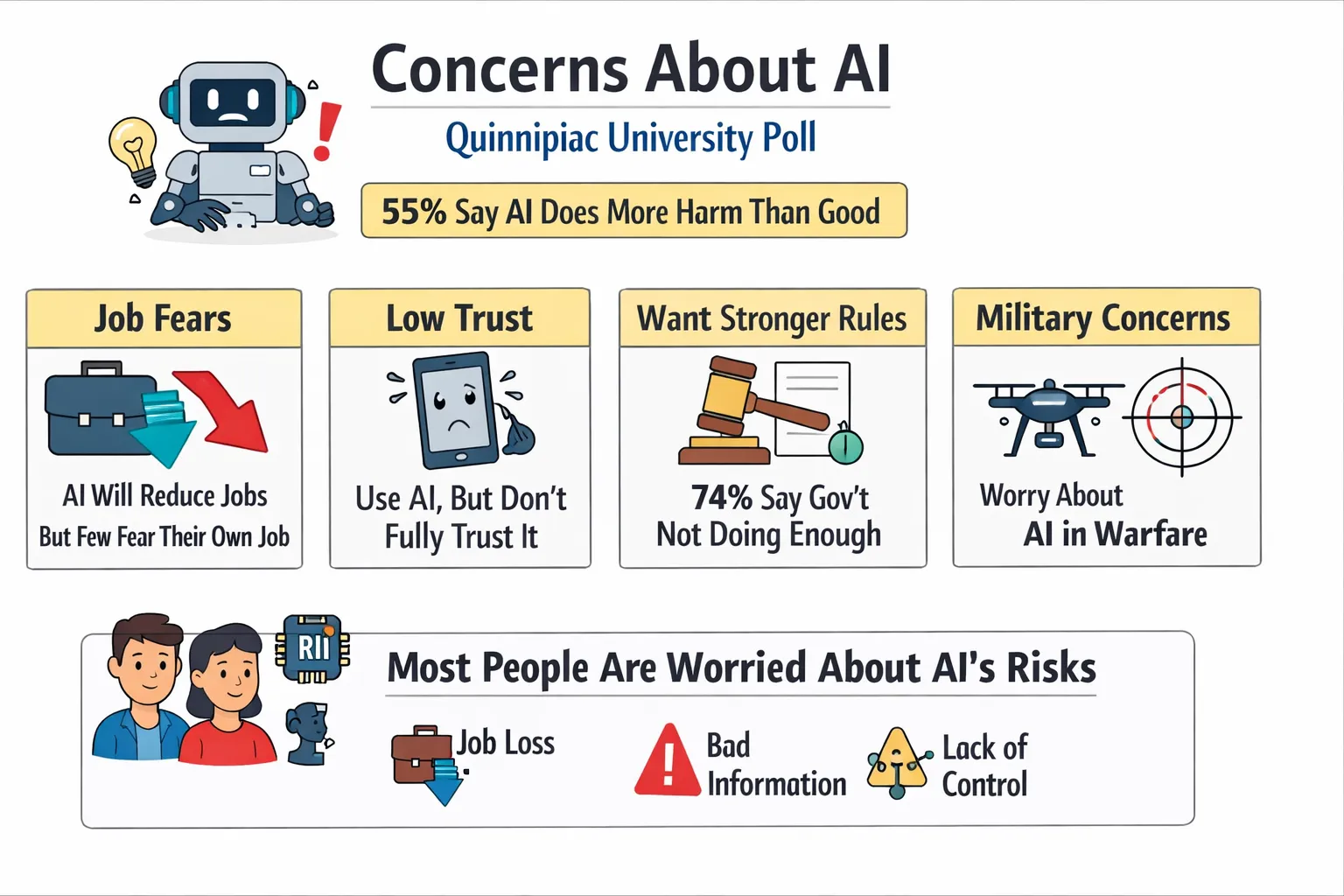
A recent survey by Quinnipiac University shows that many people in the United States are worried about artificial intelligence (AI).
📊 What most people think about AI
- About 55% of people believe AI will do more harm than good in their daily lives.
- Only around 1 in 3 people think AI will be helpful.
👉 In simple terms:
More people are negative about AI than positive.
💼 Concerns about jobs:
- Around 70% believe AI will reduce job opportunities.
- But only about 30% worry their own job is at risk.
👉 This means:
- People think AI will affect jobs in general
- But many feel their personal job is still safe
🤖 Trust in AI is low:
- Around half of people use AI tools, but
- Only a small number actually trust AI information fully
👉 So people are using AI… but not fully believing it.
⚖️ People want stronger rules:
- About 74% say the government is not doing enough to control AI
👉 In simple words:
People feel AI is growing fast, but rules are too weak.
⚔️ Concerns about misuse:
- Many people are worried about AI being used in military decisions
- A large number do not support AI choosing targets in war
👉 This shows fear about dangerous or unethical use of AI.
👥 Different age groups think differently:
- Younger people use AI more
- But they are also more worried about its impact on jobs and society
🧠 Final Simple Summary:
- Most people feel AI could be harmful
- They are especially worried about:
- Job loss
- Wrong or unreliable information
- Lack of control and rules
- Even though AI is widely used, trust in it is still low


How to Get a Job When There Are Fewer Vacancies
Looking for a job can become much more frustrating when there are fewer vacancies available. You may be checking job...

Why Is It So Hard to Get a Job in the UK in 2026?
If you have been applying for jobs in the UK and getting very few replies, you are not alone. Many...


Why Are Graduate Jobs Becoming Harder to Find in the UK?
Graduating from university is supposed to feel like the beginning of a new chapter. You finish your degree, prepare your...


Top 10 Hosting Providers for Developers
Developers assess hosting differently from most other webmasters. While absolute costs and total disk space matter, the best web hosting...


Meta and Microsoft Announce Massive Layoffs
Big tech companies like Meta Platforms and Microsoft are reducing their workforce as they spend more money on artificial intelligence...


GPT-5.5 vs Claude: Nano Banana Killer & Claude’s New Design Tool
Artificial Intelligence is evolving at an incredible pace. Every few months, new models and tools are released that push the...


Moltbook: The First Social Network for AI Agents
Artificial Intelligence is evolving rapidly. We’ve moved from simple tools to powerful AI systems that can write, design, analyze, and...


Volkswagen Uses AI Agents to Transform Its Cars in China
The automotive industry is changing faster than ever before—and at the center of this transformation is Artificial Intelligence (AI). One...

AI Is Growing Faster Than You Think
Artificial Intelligence (AI) is no longer something we only see in movies or imagine about the future. It is already...


Could AI Eliminate Humans in the Next 10 Years?
Artificial Intelligence (AI) is advancing at an incredible speed. Every day, new tools, smarter systems, and powerful technologies are being...


Meet NEO: Your New Home Robot Buddy
Imagine coming home after a long day, and instead of doing chores, managing devices, or worrying about security, everything is...


You’ve Been Using AI the Hard Way: Why Most People Use AI Inefficiently?
Artificial Intelligence is one of the most powerful tools available today. Millions of people are using AI for writing, design,...


Master AI Engineering: 20 Key Concepts Explained Simply
Artificial Intelligence (AI) is no longer a futuristic idea—it is already shaping our daily lives. From voice assistants to recommendation...


6 Ways You Are Wasting Your Time (And Don’t Even Realize It)
Time slips quietly. Not with loud warnings. Not with alarms. But in small, unnoticed habits you repeat every day. You...


How to Take Nothing Personally: 6 Powerful Ways to Protect Your Peace
Have you ever replayed a single comment in your head for hours… maybe even days? Someone said something small. Maybe...


9 Habits for Clearer Speaking I Wish I Knew Sooner
You start explaining something simple… and somehow it turns complicated. You add more words. More details. More explanation. But instead...

15 Types of Negativity to Stop (Before They Quietly Control Your Life)
Negativity doesn’t arrive loudly. It creeps in—through small doubts, silent worries, and habits you barely notice. One day, you feel...


6 Habits to Articulate Your Thoughts Like the Top 1%
Have you ever listened to someone speak and thought, “Wow… they make everything sound so simple and powerful”? And then...


The 3-2-1 Speaking Trick That Forces You To Stop Rambling
Have you ever started explaining something and then suddenly realized… you’re going in circles? You keep talking. Adding more words....


7 Skills That Will Pay You Forever – Future-Proof Your Career
In a world where industries are changing faster than ever, one thing remains constant—skills are the real currency of success....
-
 Career3 years ago
Career Opportunities for Seniors: 7 Jobs that are Perfect for Older Adults
-
 Jobs7 months ago
15 Best Second Jobs to Boost Your Income in the UK for 2026
-

 Career2 years ago
5 Free Job Posting Sites in the UK (For Employers)
-
 Money7 months ago
20 Ways to Make Money with Google Gemini: Practical Methods Anyone Can Start
-
 Money7 months ago
26 Lucrative Passive Income Ideas to Build Wealth in 2026
-

 AI & Tools7 months ago
10 Insane Ways Google Gemini Will Explode Your Productivity in 2026
-

 Job Description2 years ago
Support Worker Job Description: Qualifications, Skills, Salary, Working Hours
-

 AI & Tools7 months ago
ChatGPT vs Copilot: Which AI Is Best for You in 2026?