
AI & Tools
How HR Professionals Can Use AI in Recruitment and People Operations
See how HR professionals can use AI for recruitment, candidate communication, talent management and performance workflows while keeping human judgment at the centre.
Human Resources has always been about people. But today, HR professionals are expected to manage recruitment, employee engagement, performance tracking, and compliance—all at once.
If you work in HR, you probably know the feeling. Endless resumes. Dozens of interviews. Manual paperwork. Constant emails.
It can feel overwhelming.
Now imagine if AI could take care of the repetitive work, leaving you with more time to focus on what truly matters: building strong teams and supporting employees.
That’s exactly what modern AI tools for HR professionals are designed to do.
The challenge?
Most people don’t know where to start.
This guide explains how HR professionals can use AI across recruitment and people operations. Instead of focusing only on a list of tools, the goal is to match AI capabilities with real HR tasks while keeping human judgment at the centre.
By the end of this article, you will understand:
- How AI can simplify recruitment and HR workflows
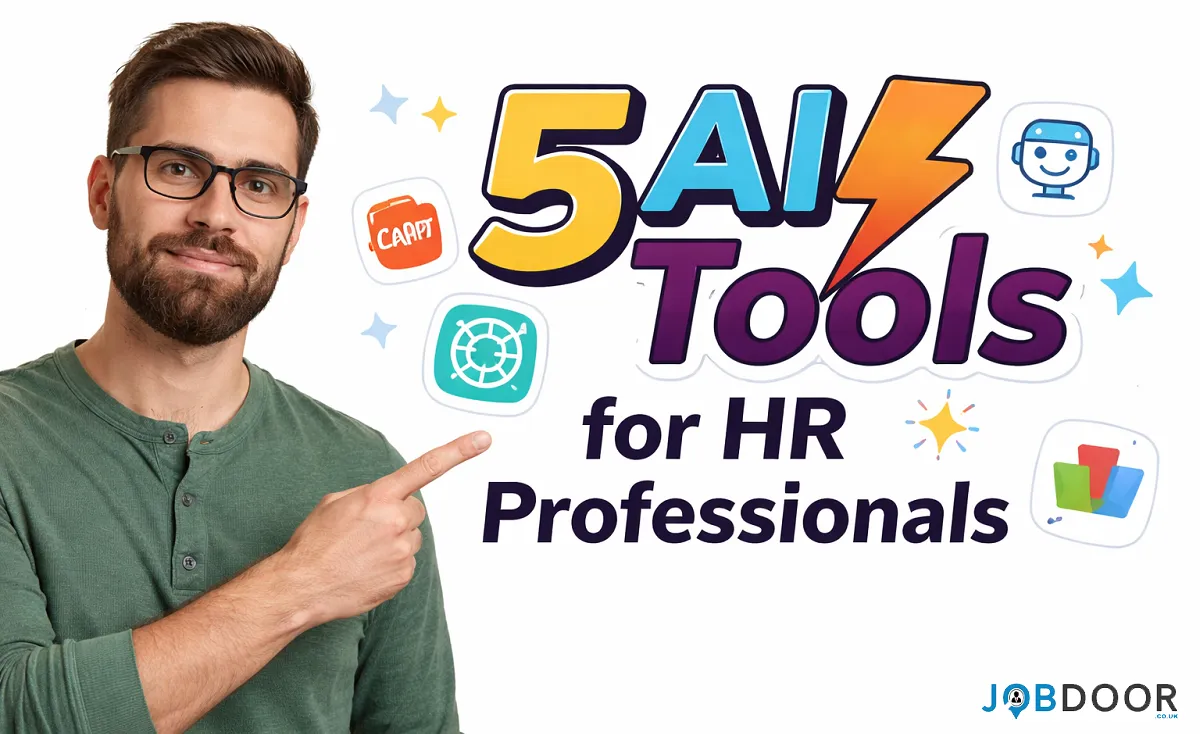
- The five most relevant AI tools for HR teams
- A step-by-step system to start using them without stress
- How to track success and improve HR performance
Let’s begin.
Why AI is Becoming Essential for HR Professionals?
HR is evolving quickly. Companies now receive hundreds or even thousands of applications for a single position.
Sorting them manually is exhausting.
AI helps by:
- Filtering resumes instantly
- Scheduling interviews automatically
- Improving candidate matching
- Analyzing employee engagement
- Reducing repetitive administrative work
But here’s the important part.
AI does not replace HR professionals.
It supports them.
Think of AI as your assistant, not your replacement.
Instead of spending hours on administrative tasks, you can focus on:
- Building relationships with employees
- Improving company culture
- Strategic hiring decisions
Now let’s look at the main AI capabilities HR teams can apply. If you are also interested in the wider impact of AI on recruitment, see how AI is changing recruitment.
1. AI-Assisted Candidate Screening and Interviews
One of the biggest HR challenges is screening candidates efficiently.
Imagine receiving 800 applications for a job opening.
Reading every resume and conducting preliminary interviews manually could take weeks.
How HireVue Helps?
Platforms such as HireVue use AI-assisted workflows to help recruitment teams organise and evaluate candidate information more efficiently. Exact capabilities vary by product and hiring setup, so HR teams should review how a system reaches and presents its recommendations.
For example, an AI-supported interview workflow may help with:
- Candidate video interviews
- Speech patterns
- Skills and responses
- Job compatibility
Instead of scheduling every initial conversation live, candidates can complete structured interview steps at a suitable time.
The important HR role remains reviewing evidence, checking for bias and making the final assessment rather than accepting an automated score without review.
Key Benefits:
- Faster hiring process
- Reduced recruiter workload
- Standardized interviews
- Better candidate insights
Simple Example:
Think of it like pre-recorded interviews.
Candidates answer questions on their own time, and you review them later.
No scheduling chaos.
Just clarity.
2. Skills-Based Assessments and Candidate Matching
Resumes don’t always reveal a person’s true abilities.
Someone might look perfect on paper but struggle in real job situations.
This is where skills-based assessment platforms can add value. Pymetrics is now part of Harver, which provides assessment and hiring technology for organisations.
What Makes Skills-Based Assessment Useful?
Instead of relying only on resumes, modern assessment platforms can evaluate job-relevant skills through structured assessments. HR teams should validate that the assessment is relevant to the role and does not introduce unfair barriers.
These short assessments measure traits like:
- Problem solving
- Risk tolerance
- Emotional intelligence
- Decision making
- Focus and attention
Depending on the platform and assessment design, results can help recruiters compare candidates against defined job requirements or skills frameworks.
The result?
Better hiring matches.
Why HR Teams Love It?
- Reduces hiring bias
- Identifies hidden talent
- Focuses on real skills rather than just resumes
A Simple Way to Understand It:
Imagine hiring based on how people think, not just what they wrote on their resume.
The broader idea is simple: use structured evidence alongside the CV and interview rather than relying on one source of information.
3. Paradox (Olivia) – AI Recruiting Assistant:
Recruiters spend a huge amount of time answering simple questions:
- “Did you receive my application?”
- “When is my interview?”
- “What is the job description?”
These messages pile up quickly.
Paradox solves this with an AI assistant called Olivia.
What Olivia Does?
Olivia works like a smart recruiting chatbot that can:
- Answer candidate questions instantly
- Schedule interviews automatically
- Send reminders to applicants
- Collect candidate information
The best part?
It works 24/7.
Candidates get instant responses, and HR teams save hours every week.
Benefits:
- Faster communication
- Better candidate experience
- Less administrative work
You step in only when human judgment is needed.
4. Eightfold AI – Intelligent Talent Management
Hiring is only one part of HR.
The real challenge is managing and growing talent inside the company.
Eightfold AI focuses on exactly that.
What Eightfold AI Does?
It analyzes employee data to help companies:
- Identify internal talent
- Recommend career paths
- Suggest training opportunities
- Improve workforce planning
In simple terms, it helps HR teams develop employees instead of constantly hiring new ones.
Why This Matters?
Employee retention is expensive.
Replacing workers costs companies thousands of dollars.
Eightfold AI helps organizations retain talent by identifying growth opportunities.
Eightfold AI can detect this and recommend a data analytics role or training program.
This keeps employees engaged and motivated.
5. Lattice – AI-Supported Employee Performance Management
Performance reviews are another major HR responsibility.
But traditional reviews often feel:
- Infrequent
- Subjective
- Stressful
Lattice modernizes this process.
How Lattice Works?
Lattice helps HR teams:
- Track employee goals
- Monitor progress
- Gather feedback
- Measure performance trends
AI analyzes performance data to provide insights about:
- Employee engagement
- Productivity
- Growth opportunities
Why It Matters?
Instead of waiting for annual reviews, companies can monitor performance continuously.
Employees also receive more consistent feedback, which improves development.
A Simple 4-Step System for Using AI in HR:
If all of this sounds overwhelming, don’t worry.
You don’t need to adopt every tool at once.
Start small.
Here is a simple system you can follow.
Step 1: Identify Your Biggest HR Bottleneck
Ask yourself:
- Is recruitment taking too long?
- Are interviews difficult to manage?
- Is employee performance hard to track?
Choose one problem to solve first.
Example:
If recruitment is slow, start with HireVue or Paradox.
Step 2: Implement One Tool at a Time
Trying multiple tools simultaneously often leads to confusion.
Instead:
- Choose one AI tool
- Train your HR team
- Run a small pilot program
- Gather feedback
Once it works well, expand gradually.
Step 3: Combine AI With Human Judgment
AI is powerful.
But it should never replace human decision-making.
Use AI to:
- Filter data
- Analyze trends
- Automate repetitive tasks
Use human intuition to:
- Make hiring decisions
- Understand employee emotions
- Build relationships
This balance is where the real magic happens.
Step 4: Track Your Results
How do you know if AI is helping?
Measure key HR metrics such as:
| Metric | What It Shows |
|---|---|
| Time to hire | How quickly positions are filled |
| Candidate satisfaction | Interview experience quality |
| Employee retention | How many employees stay |
| Hiring quality | Performance of new hires |
Even small improvements can make a huge difference over time.
Common Mistakes HR Teams Make With AI:
Many organizations adopt AI but fail to get real results.
Why?
Because of these common mistakes.
1. Using Too Many Tools:
More tools does not mean better results.
Focus on the tools that solve real problems.
2. Ignoring Employee Training:
New technology requires training.
Without proper guidance, teams may avoid using the tool entirely.
3. Expecting Instant Results:
AI improves processes gradually.
Think of it as long-term optimization, not instant transformation.
The Mindset Shift HR Professionals Need:
Using AI effectively starts with the right mindset.
Some HR professionals worry that AI will make their roles less valuable.
The truth is the opposite.
AI removes repetitive tasks, allowing HR professionals to focus on:
- Leadership
- Strategy
- Employee development
- Culture building
The future HR professional is not replaced by AI.
They are empowered by it.
The Future of AI in Human Resources:
The HR industry is entering a new era.
In the coming years, AI will help companies:
- Predict employee turnover
- Improve workplace wellbeing
- Personalize employee development
- Optimize hiring decisions
Organizations that adopt these technologies early will have a huge competitive advantage.
HR professionals who build practical AI literacy can spend less time on repetitive administration and more time on workforce planning, employee development and sound people decisions.
Questions HR Teams Should Ask Before Using AI
Can AI make hiring decisions for HR?
AI can support screening, matching, scheduling and analysis, but important hiring decisions should remain subject to human review. HR teams should also check for bias, explainability, privacy and compliance requirements.
What HR tasks are best suited to AI?
Repetitive, rules-based or information-heavy tasks are often good starting points. Examples include interview scheduling, candidate communication, document summarisation, reporting and workflow automation.
How should HR teams choose an AI tool?
Start with the problem rather than the technology. Define the task, check the tool’s data practices, test it with a small pilot, involve HR and legal stakeholders where appropriate, and measure the result before expanding.
What are the main risks of AI in HR?
Key risks include biased outcomes, poor-quality data, privacy problems, over-reliance on automated recommendations and unclear accountability. AI should support a documented HR process rather than replace responsible decision-making.
Final Thoughts
If HR tasks feel overwhelming, you’re not alone.
Recruitment pressure, employee expectations, and administrative work can create constant stress.
But AI offers a solution.
Not a complicated one.
A practical one.
By using tools like:
- HireVue for smarter interviews
- Skills-based assessment platforms for structured candidate evaluation
- Paradox for automated recruiting
- Eightfold AI for talent management
- Lattice for performance tracking
You can transform HR from a reactive role into a strategic powerhouse.
Remember this simple approach:
- Identify one HR problem
- Choose one AI tool
- Implement gradually
- Measure results
Small steps lead to big improvements.
The most important thing?
Start today.
Because the future of HR is not just about managing people.
It’s about empowering them with the right technology.









How to Start a Career in Hospitality in the UK
Thinking about hospitality as a career in the UK? Compare hotel, restaurant and guest service roles, entry routes, skills, apprenticeships...


How to Start a Career in Retail in the UK
Thinking about a retail career in the UK? Compare retail roles, entry routes, apprenticeships, skills, experience, CV tips and ways...


How to Start a Career in Science and Research in the UK
Planning a science or research career in the UK? Compare career paths, qualifications, apprenticeships, skills and practical ways to get...


How to Start a Career in Law in the UK
Thinking about a career in law? This guide explains UK legal career routes, qualifications, solicitor and barrister pathways, apprenticeships, skills,...


How to Start a Career in Education in the UK
Thinking about a career in education? Compare teaching and non-teaching roles, qualifications, apprenticeships, experience, skills and practical steps for getting...


How to Start a Career in Marketing in the UK
Marketing is a broad career field that combines communication, creativity, research, data and business thinking. It includes traditional marketing as...


How to Start a Career in Healthcare in the UK
Healthcare is one of the UK’s broadest career areas. It includes doctors and nurses, but also healthcare assistants, laboratory staff,...


How to Start a Career in Human Resources (HR) in the UK
Photo by Vitaly Gariev on Unsplash Human resources, usually called HR, is a people-focused career that combines communication, organisation, business...


How to Start a Career in Construction in the UK
Construction is one of the UK’s broadest career sectors. It includes hands-on trades such as bricklaying, carpentry and plumbing, as...


How to Start a Career in Energy and Utilities in the UK
Planning a career in energy and utilities in the UK? See job options, apprenticeships, qualifications, skills and practical steps to...


How to Start a Career in Media and Communications in the UK
Planning a media and communications career in the UK? Compare job options, entry routes, apprenticeships, skills, experience and practical steps...


How to Start a Career in Environmental and Sustainability Jobs in the UK
Environmental and sustainability careers are becoming an important part of many UK workplaces. Jobs in this area can involve protecting...


How to Start a Career in Cybersecurity in the UK
Thinking about a cybersecurity career in the UK? Here is a practical guide to skills, qualifications, entry-level roles, applications and...


How to Start a Career in Engineering in the UK
Thinking about engineering as a career in the UK? Here is a practical guide to engineering fields, qualifications, apprenticeships, skills,...


How to Start a Career in Government and Public Services in the UK
Thinking about a career in government or public services? This guide covers job options, entry routes, apprenticeships, skills, applications and...


Rolls-Royce Internship UK: Eligibility, Opportunities & How to Apply
Find Rolls-Royce internships in the UK with practical guidance on eligibility, opportunities, applications, assessments, skills and preparation.


How to Start a Career in Transport and Logistics in the UK
Planning a career in transport and logistics in the UK? See entry-level roles, apprenticeships, qualifications, skills and practical steps to...
JLR Internships in the UK: How to Find and Apply
Find JLR internships and undergraduate placements in the UK, with practical guidance on eligibility, applications, career areas, assessments and preparation.


How to Start a Career in Architecture and Design in the UK
How to Start a Career in Architecture and Design in the UK Architecture and design careers combine creativity with practical...


Technology Internships in the UK: How to Find and Prepare
Find technology internships in the UK with practical guidance on choosing a tech career area, building skills, finding employers and...
-
 Career3 years ago
Flexible Jobs for Older Adults in the UK: 7 Career Options
-
 Jobs8 months ago
Second Jobs in the UK: 15 Practical Ways to Earn Extra Income
-
 How-to8 months ago
How to Use Google Gemini for Freelance Work and Career Skills
-

 Career2 years ago
Free Job Posting Sites in the UK: Options for Employers
-
 How-to8 months ago
How to Build Passive Income: 20 Income-Producing Assets for Long-Term Financial Growth
-
 AI & Tools8 months ago
How to Use Google Gemini for Productivity at Work
-

 Job Description3 years ago
Support Worker Job Description: Duties, Skills, Salary and Career Guide UK
-

 AI & Tools8 months ago
ChatGPT vs Microsoft Copilot: Which AI Is Best for You?