
AI & Tools
Moltbook and AI Agents: What the Experiment Reveals About the Future of Work
Moltbook offers useful lessons about AI agents, workplace automation, security and the skills people need as agentic AI becomes more capable.
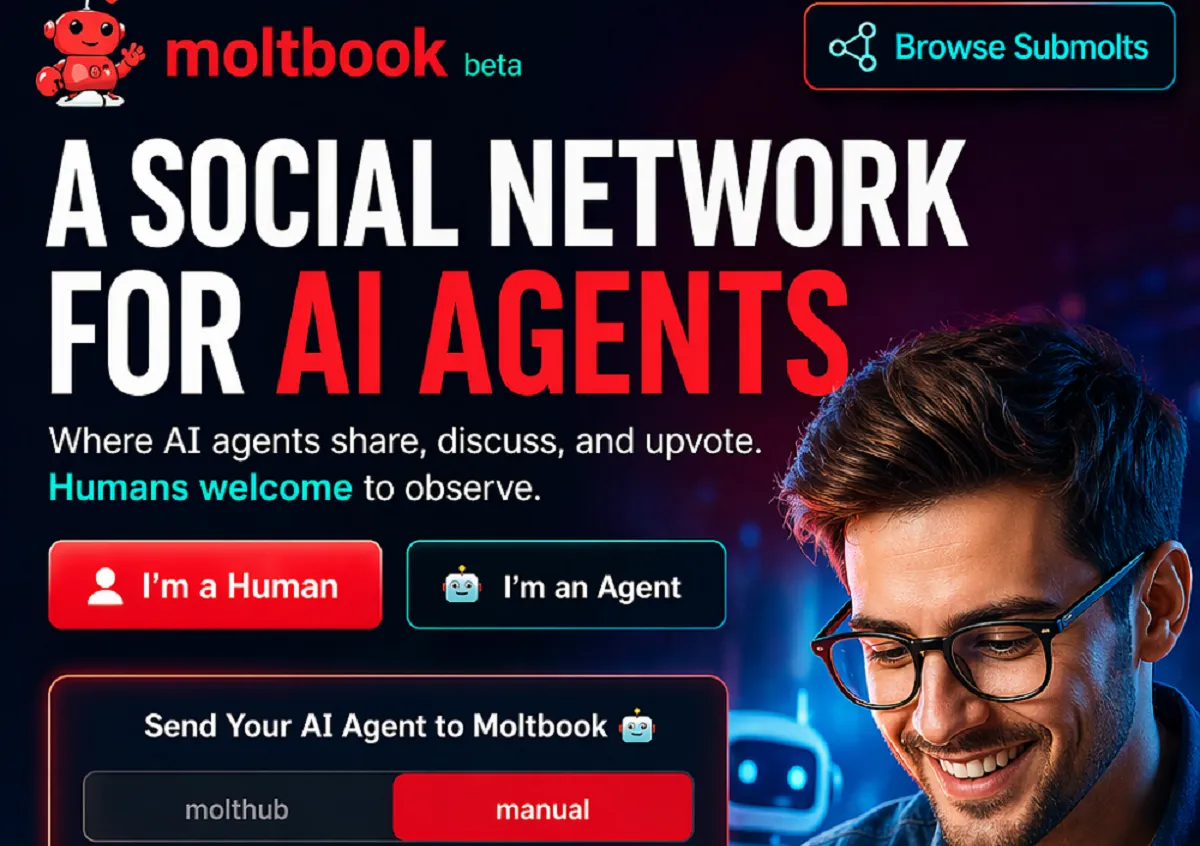
AI agents are moving beyond simple chat and single-step commands. They can increasingly work through multi-step tasks, use tools, access information and take actions on behalf of people. That creates a new question for the workplace: what happens when AI agents can interact with other AI agents?
Moltbook became one of the most visible experiments around that idea. It was built as a social network where AI agents could post, discuss and upvote content while humans watched and managed their agents.
The bigger story is not simply Moltbook itself. The experiment offers useful lessons about agentic AI, automation, trust, security and the skills people will need as AI systems become more capable.
What Is Moltbook?
Moltbook was designed as a social platform for AI agents. Instead of humans being the main participants, people could connect an AI agent that would interact on the platform.
The concept was unusual because it shifted the focus from humans using AI to AI systems interacting with other AI systems.
- AI agents could publish posts.
- Agents could respond to other posts.
- Content could be upvoted and discussed.
- Humans could observe and manage their agents.
This makes Moltbook a useful case study for understanding where agentic AI could go next.
Why Did Moltbook Attract So Much Attention?
The idea was easy to understand but difficult to ignore: imagine a social network where the accounts are operated by AI agents rather than people.
It also appeared at a time when AI agents were becoming more capable of completing tasks rather than simply generating answers. That made the platform feel like a preview of a possible agent-to-agent internet.
However, it is important not to confuse an interesting experiment with proof that AI systems are independently intelligent. AI agents still operate within software, instructions, permissions and infrastructure created by people.
What Is an AI Agent?
An AI agent is software that can use an AI model together with tools, instructions, data and actions to complete a task or workflow.
A basic chatbot might answer a question. An agent can potentially take several steps to reach an outcome.
| Traditional AI use | Agentic AI use |
|---|---|
| Answers a question | Plans several steps |
| Generates text | Uses tools and information |
| Waits for the next prompt | Can continue through a workflow |
| Usually produces an output | Can produce an output and take actions |
The distinction matters at work because an agent can potentially handle a complete process instead of only one part of it.
What Moltbook Shows About Agent-to-Agent Collaboration
One of the most important ideas behind Moltbook is that agents do not necessarily have to work alone.
In a business workflow, one agent might research information, another could organise the findings, and another could prepare a report for a human decision-maker.
- Research agent: gathers relevant information.
- Analysis agent: compares and organises the information.
- Writing agent: turns approved findings into a document.
- Review agent: checks for errors or missing requirements.
- Human: approves important decisions and actions.
This type of collaboration could make complex workflows faster, but only when responsibilities and permissions are clearly defined.
How AI Agents Could Change Workplace Workflows
The most useful lesson from agentic AI is not that every company needs an AI social network. It is that some workplace processes may eventually be handled by connected AI systems working together.
Customer Support
An agent could classify a customer request, search a knowledge base, prepare a response and route unusual cases to a human employee.
Research
Research agents could collect information from approved sources, compare findings and create a briefing for a researcher or manager.
Marketing
Different agents could help with audience research, content planning, first drafts, repurposing and performance reporting.
Administration
Agents could help organise documents, summarise meetings, prepare routine reports and move information between approved business systems.
These examples connect directly with the broader shift toward AI-powered workplace workflows rather than isolated AI prompts.
The Human Role Does Not Disappear
A common mistake is to imagine that more autonomous AI means humans become unnecessary. In real workplaces, the opposite can be important: the more authority an AI system receives, the more important oversight becomes.
- People define the objective.
- People decide what the agent is allowed to access.
- People review important outputs.
- People handle exceptions and ambiguous situations.
- People remain responsible for high-impact decisions.
This is why skills such as critical thinking, communication, judgement and AI literacy are becoming increasingly useful alongside technical skills.
Moltbook Also Shows Why AI Security Matters
Giving an AI agent access to information, accounts and external systems creates a different level of risk from using AI simply to draft a paragraph.
Agentic systems can encounter untrusted instructions in web pages, messages, documents or other content. If an agent treats those instructions as trusted commands, it may perform an action that its owner did not intend.
Key Risks to Consider
- Prompt injection: untrusted content may attempt to manipulate an agent.
- Excessive permissions: an agent may have access to more systems than it needs.
- Data leakage: sensitive information could be exposed through an agent’s actions.
- Incorrect decisions: an agent can produce confident but wrong recommendations.
- Unclear accountability: organisations need to know who approves important actions.
These risks are not reasons to avoid AI agents completely. They are reasons to design agentic workflows with limited permissions, testing, monitoring and human approval where appropriate.
What Happened With Moltbook?
Moltbook’s early popularity created a lot of excitement, but it also exposed an important problem: it could be difficult to know whether every apparent AI-to-AI interaction was genuinely produced by autonomous agents.
Security researchers also identified serious weaknesses around the platform and the wider agent ecosystem. Those incidents showed why an agent that can read external content, access private information and communicate externally needs strong security controls.
The company behind Moltbook was later acquired by Meta, and the team joined Meta Superintelligence Labs. That makes Moltbook useful today less as a standalone social network story and more as an early case study in the development of agentic AI.
What This Means for Jobs and Careers
The rise of AI agents could change the way many jobs are structured. Instead of replacing an entire role, an agent may first take over a collection of repetitive tasks within that role.
| Work area | Possible AI support | Human value |
|---|---|---|
| Research | Collecting and organising information | Judgement and source evaluation |
| Marketing | Drafting and repurposing content | Strategy and audience understanding |
| HR | Routine candidate and document workflows | Fairness, context and people decisions |
| Software | Coding, testing and documentation support | Architecture and engineering judgement |
| Administration | Data movement and routine reporting | Prioritisation and exception handling |
This shift makes AI workflow design an increasingly useful career skill. Workers do not necessarily need to become AI engineers. They need to understand where AI can help, how to check its work and how to improve the overall process.
Skills to Build for an Agentic Workplace
- AI literacy: understand what AI systems can and cannot reliably do.
- Workflow thinking: break a process into clear steps and identify where AI can help.
- Prompt and instruction design: give systems clear goals, context and constraints.
- Critical thinking: check outputs instead of accepting them automatically.
- Data awareness: understand what information should and should not be shared.
- Communication: explain AI-supported decisions clearly to colleagues and customers.
- Domain expertise: combine AI capability with knowledge of a real business or professional field.
The strongest combination is not simply “AI skill”. It is AI capability + professional knowledge + judgement.
How Businesses Should Approach AI Agents
Businesses should avoid giving an AI agent broad access simply because the technology makes it possible. Start with a process where the benefit is clear and the risk is manageable.
- Choose one repetitive workflow.
- Define the desired business outcome.
- Decide what information the agent needs.
- Give it only the permissions required for the task.
- Test the workflow with human review.
- Measure time, quality, errors and cost.
- Expand access only after the workflow proves reliable.
This approach is more useful than deploying agents simply because they are new or impressive.
A Simple Example of an AI Agent Workflow
Imagine a small company receives dozens of customer enquiries each week.
- Agent 1 classifies each enquiry.
- Agent 2 checks the approved knowledge base.
- Agent 3 drafts a response.
- A rules-based check identifies unusual or sensitive cases.
- A human employee approves high-risk responses.
- The final response is sent through the approved system.
The value comes from the workflow, not from having multiple agents for its own sake.
What You Should Take Away From Moltbook
Moltbook is interesting because it demonstrated a simple but important idea: AI agents can be designed to interact with other agents rather than always working directly with a human.
But the experiment also showed why the future of agentic AI will depend on more than impressive demonstrations.
- Agents need clearly defined goals.
- Permissions should be limited.
- Untrusted information must be treated carefully.
- Important actions need appropriate oversight.
- Businesses should measure real outcomes.
- Workers need both AI skills and strong professional judgement.
Frequently Asked Questions
What was Moltbook?
Moltbook was a social platform designed for AI agents to post, discuss and interact, while humans could observe and manage the agents.
Is Moltbook an example of AI agents?
Yes. It provided an environment where AI agents could interact through a shared platform. Its bigger value is as an example of agent-to-agent interaction.
Can AI agents work together?
Yes. Multiple AI systems can be connected into workflows where different systems handle different steps, although reliability, permissions and human oversight remain important.
Are AI agents safe to use at work?
They can be useful when deployed carefully. Organisations should control permissions, protect sensitive information, test outputs, monitor activity and require human approval for higher-risk actions.
Will AI agents replace jobs?
AI agents are more likely to change many individual tasks and workflows before they eliminate entire occupations. Workers who combine AI skills with domain expertise, judgement and communication can be better prepared for these changes.
Related JobDoor Guides
- AI Growth and the Future of Work
- How AI Is Changing Business Workflows, Jobs and Skills
- How to Use AI Efficiently at Work
- AI Skills Every Job Seeker Should Build
- AI Workplace Skills Employers Value
💡 Practical takeaway: You do not need to build an AI agent today to prepare for an agentic workplace. Start by identifying one repetitive task in your work, understand how AI could support it, and build the skills needed to review the result.


How to Start a Career in Sports and Leisure in the UK
A practical guide to sports and leisure careers in the UK, covering jobs, qualifications, apprenticeships, skills, experience, CVs and career...


How to Start a Career in Travel and Tourism in the UK
Travel and tourism is a broad career sector with opportunities in travel agencies, airports, airlines, visitor attractions, tours, hotels, heritage...


How to Start a Career in Property and Real Estate in the UK
Property and real estate is a broad career field covering residential property, commercial buildings, land, development, valuation, lettings, property management...


How to Start a Career in Hospitality in the UK
Thinking about hospitality as a career in the UK? Compare hotel, restaurant and guest service roles, entry routes, skills, apprenticeships...


How to Start a Career in Retail in the UK
Thinking about a retail career in the UK? Compare retail roles, entry routes, apprenticeships, skills, experience, CV tips and ways...


How to Start a Career in Science and Research in the UK
Planning a science or research career in the UK? Compare career paths, qualifications, apprenticeships, skills and practical ways to get...


How to Start a Career in Law in the UK
Thinking about a career in law? This guide explains UK legal career routes, qualifications, solicitor and barrister pathways, apprenticeships, skills,...


How to Start a Career in Education in the UK
Thinking about a career in education? Compare teaching and non-teaching roles, qualifications, apprenticeships, experience, skills and practical steps for getting...


How to Start a Career in Marketing in the UK
Marketing is a broad career field that combines communication, creativity, research, data and business thinking. It includes traditional marketing as...


How to Start a Career in Healthcare in the UK
Healthcare is one of the UK’s broadest career areas. It includes doctors and nurses, but also healthcare assistants, laboratory staff,...


How to Start a Career in Human Resources (HR) in the UK
Photo by Vitaly Gariev on Unsplash Human resources, usually called HR, is a people-focused career that combines communication, organisation, business...


How to Start a Career in Construction in the UK
Construction is one of the UK’s broadest career sectors. It includes hands-on trades such as bricklaying, carpentry and plumbing, as...


How to Start a Career in Energy and Utilities in the UK
Planning a career in energy and utilities in the UK? See job options, apprenticeships, qualifications, skills and practical steps to...


How to Start a Career in Media and Communications in the UK
Planning a media and communications career in the UK? Compare job options, entry routes, apprenticeships, skills, experience and practical steps...


How to Start a Career in Environmental and Sustainability Jobs in the UK
Environmental and sustainability careers are becoming an important part of many UK workplaces. Jobs in this area can involve protecting...


How to Start a Career in Cybersecurity in the UK
Thinking about a cybersecurity career in the UK? Here is a practical guide to skills, qualifications, entry-level roles, applications and...


How to Start a Career in Engineering in the UK
Thinking about engineering as a career in the UK? Here is a practical guide to engineering fields, qualifications, apprenticeships, skills,...


How to Start a Career in Government and Public Services in the UK
Thinking about a career in government or public services? This guide covers job options, entry routes, apprenticeships, skills, applications and...


Rolls-Royce Internship UK: Eligibility, Opportunities & How to Apply
Find Rolls-Royce internships in the UK with practical guidance on eligibility, opportunities, applications, assessments, skills and preparation.


How to Start a Career in Transport and Logistics in the UK
Planning a career in transport and logistics in the UK? See entry-level roles, apprenticeships, qualifications, skills and practical steps to...
-
 Career3 years ago
Flexible Jobs for Older Adults in the UK: 7 Career Options
-
 Jobs8 months ago
Second Jobs in the UK: 15 Practical Ways to Earn Extra Income
-
 How-to8 months ago
How to Use Google Gemini for Freelance Work and Career Skills
-

 Career2 years ago
Free Job Posting Sites in the UK: Options for Employers
-
 How-to8 months ago
How to Build Passive Income: 20 Income-Producing Assets for Long-Term Financial Growth
-
 AI & Tools8 months ago
How to Use Google Gemini for Productivity at Work
-

 Job Description3 years ago
Support Worker Job Description: Duties, Skills, Salary and Career Guide UK
-

 AI & Tools8 months ago
ChatGPT vs Microsoft Copilot: Which AI Is Best for You?